
Table of Contents
- What You’ll Need Before Legalising Cross-Border Contracts
- Step 1: Confirm the Destination Jurisdiction’s Requirements
- Step 2: Notarisation of International Business Documents
- Step 3: Apostille Requirements for Commercial Contracts
- Step 4: Legalisation of Documents for Overseas Use
- Common Mistakes When Legalising Cross-Border Contracts
- Conclusion
- Frequently Asked Questions
Last Updated: October 2, 2026
What You’ll Need Before Legalising Cross-Border Contracts
Legalisation for cross border contracts is the process of authenticating signatures, seals, and corporate documents so a foreign authority will accept them as valid. Get it wrong and a deal can stall for weeks.
Often once an agreement is signed, everyone relaxes, then the destination registry rejects the paperwork. The fix is straightforward: prepare correctly before anything is signed.
The stakes are real and the mismatch can cause serious delays.
Before you start, gather these items:
- Certified copies of the company’s certificate of incorporation
- Board resolutions authorising the signatory
- A current register of directors and secretary
- Passport or ID for each signatory
- The full contract, including all schedules
- Any powers of attorney used in the deal
Missing any of these slows the whole chain. Below, we walk through each step in order, from confirming what the destination country wants to the final legalisation stamp.
Step 1: Confirm the Destination Jurisdiction’s Requirements
Requirements differ by country, and some contracts attract extra scrutiny. Some states demand an apostille. Others insist on full consular legalisation. A few want both, plus a certified translation.
Start by asking the receiving authority three questions:
- Does it accept an apostille, or does it need embassy legalisation?
- Does it require a certified translation, and into which language?
- Does it need the notary to certify capacity as well as signature?
The answer changes your route entirely. A country inside the Hague Apostille Convention usually accepts a single apostille stamp. A country outside it typically needs the document legalised by its own embassy or consulate after the apostille stage.
Regulatory bodies are widening their reviews of foreign ownership and national security agreements. That means some destinations now ask for extra corporate evidence before they will register a contract.
Step 2: Notarisation of International Business Documents
Notarisation of international business documents is the act of a notary public verifying the identity of signatories and witnessing their signatures. It is the first formal step in the chain, and everything after it depends on it being done correctly.
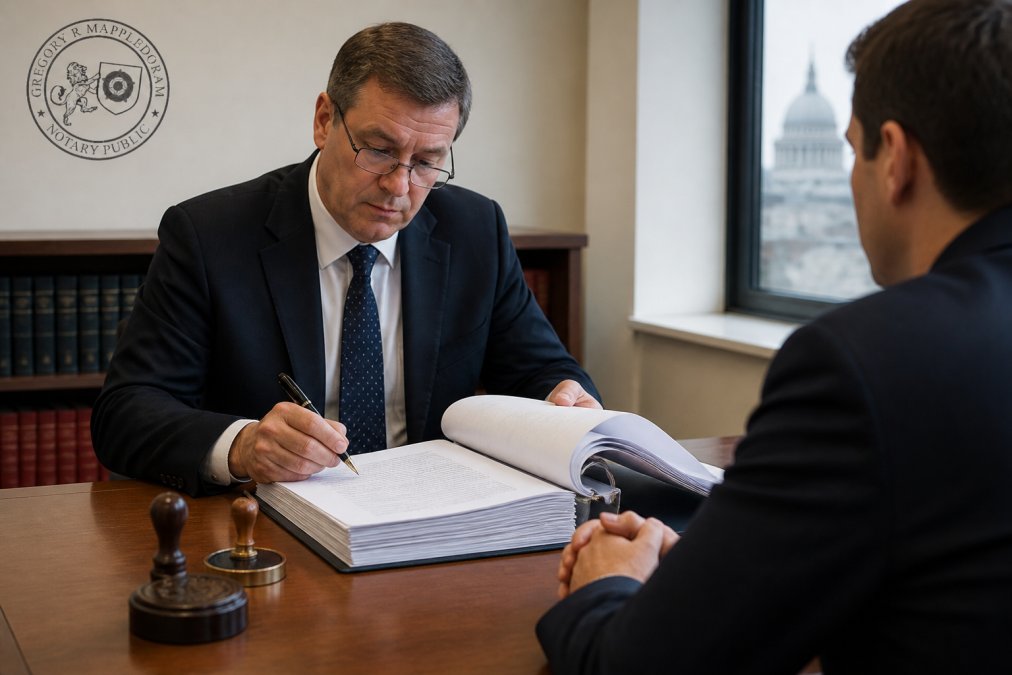
A notary checks more than a signature, expect the notary to confirm:
- The signatory is who they claim to be
- The signatory has authority to bind the company
- The company exists and is in good standing
- Any power of attorney is valid and properly executed
The document then receives a notarial certificate. This is the page foreign authorities actually read. If the wording is wrong, the rest of the chain collapses.
This is where experience matters. A notary who understands commercial context will catch a resolution that does not actually authorise the signatory, or a certificate that names the wrong entity. Catching that early is far cheaper than catching it at the embassy.
Step 3: Apostille Requirements for Commercial Contracts
Apostille requirements for commercial contracts are met when the Foreign, Commonwealth & Development Office attaches an apostille certificate to a notarised document. The apostille confirms the notary’s signature and seal are genuine.
The apostille itself does not prove the contract is valid. It proves the notary is real. That distinction trips people up constantly.
The process runs like this:
- The document is notarised first
- The notarised document is submitted for an apostille
- The apostille is attached to the notarial certificate, not the contract
- The document is then ready for use in the destination country
Apostilles work only between countries that have signed the Hague Apostille Convention. If the destination is not a member, you skip this step and go straight to consular legalisation.
|
Step |
What Happens |
Who Acts |
|---|---|---|
|
Notarisation |
Signature and authority verified |
Notary public |
|
Apostille |
Notary’s seal authenticated |
FCDO |
|
Legalisation |
Embassy stamps the document |
Destination consulate |
|
Translation |
Certified translation added |
Sworn translator |
Step 4: Legalisation of Documents for Overseas Use
Legalisation of documents for overseas use is the final stage, where the destination country’s embassy or consulate stamps the document to confirm the apostille or notarial seal. It is required for countries outside the Hague Convention.
This stage is slower and less predictable than the apostille. Consulates set their own timelines, fees, and document formats. Some accept walk-in submissions. Others require appointments weeks in advance or only accept postal applications.
Common Mistakes When Legalising Cross-Border Contracts
Mistakes cluster in predictable places. Fixing them before you file saves days.
- Notarising after signing the wrong version. Always notarise the final, executed version.
- Assuming an apostille is enough. Check whether the destination is in the Hague Convention.
- Skipping the translation. Some registries reject untranslated documents outright.
- Using a certificate with the wrong entity name. Match the legal name exactly.
- Leaving legalisation to the last week. Consulate timelines are not negotiable.
- Forgetting the signatory’s capacity. Authority must be proven, not assumed.
The single biggest cause of rejection is a mismatch between what the destination asked for and what was submitted. That is a preparation failure, not a legal one.
Conclusion
Cross-border documentation rewards preparation and punishes improvisation. Confirm the destination’s rules, notarise correctly, apostille where required, and legalise through the right consulate in the right order.
Gregory Mappledoram, Notary Public handles each stage including for time-pressured closings, more than 18 years of notarial practice, and a background of 25 years as a General Counsel. Documents are prepared to work in the destination jurisdiction, backed by professional indemnity and fidelity cover.
Contact Gregory to get your international contracts notarised, apostilled, and legalised correctly the first time.
Frequently Asked Questions
Do cross-border contracts require an apostille?
It depends on the destination country. If it is a signatory to the Hague Apostille Convention, an apostille issued by the Foreign, Commonwealth & Development Office (FCDO) is usually sufficient. For non-signatory states, you will need full consular legalisation through the relevant embassy or high commission. Always confirm the specific requirement with the receiving authority before instructing a notary, as telecoms regulators in some jurisdictions impose additional authentication steps.
How does the Hague Convention affect contract legalisation?
The Hague Apostille Convention replaces lengthy consular legalisation with a single apostille certificate for documents moving between member states. For cross-border contracts, this can cut processing time from weeks to days. However, some countries still require extra steps for commercial documents, so check the HCCH status table and the destination regulator’s guidance before assuming the apostille route applies.
What is the role of a Notary Public in international commercial law?
A Notary Public is an officer of the law authorised to verify signatures, certify document authenticity and witness executions for use abroad. In the context of cross-border contracts, the notary confirms the signatory’s identity and authority, certifies copies of board resolutions and company registers, and prepares the document for apostille or consular legalisation. Their seal and signature are what foreign authorities rely on to accept the document.
Are there specific requirements for notarising technical service agreements?
Technical service agreements often include schedules, annexes and technical specifications that also need certification. Ensure every page is accounted for and that any exhibits referenced in the contract are attached. Some jurisdictions require the notary to confirm the signatory’s corporate authority, so have board resolutions or a power of attorney ready. If the agreement is governed by foreign law, check whether the destination state requires a certified translation alongside the notarised original.