Author: Admin

  • Document Legalisation for Technology Sector

    Document Legalisation for Technology Sector

    Table of Contents

    Last Updated: October 9, 2026

    Document Legalisation for Technology Sector: What Changes When You Cross Borders

    Document legalisation for technology sector deals is rarely simple. A UK-incorporated software company filing a merger notification abroad, or a telecoms group registering IP in a new market, will find that foreign authorities want proof the paperwork is genuine. That proof comes through notarisation, then an (apostille or consular legalisation). At Gregory Mappledoram Notary Public, we handle this daily for in-house counsel and corporate secretaries who cannot afford a rejected filing. Below, we explain what typically needs legalising and how the process actually runs.

    Document legalisation is the process of confirming that a document’s signature, seal, or status is genuine so a foreign authority will accept it. It usually means notarisation first, then an apostille or consular legalisation depending on the destination.

    The destination country decides everything. If it is part of the Hague Apostille Convention, a single apostille usually suffices. If not, documents may need consular legalisation, which takes longer and costs more in time.

    Technology companies face a particular problem: their corporate structures change fast. A board resolution signed last month may be superseded by a new one this month. Foreign registries notice. So do counterparties in a merger.

    Technology Company Documents for Overseas Use: What Typically Needs Legalising

    Technology company documents for overseas use usually fall into two groups: corporate records that prove the company exists and is properly governed, and commercial documents that prove specific transactions or rights.

    The exact list depends on what the receiving authority asks for. But most requests cover the same core items.

    Corporate and Constitutional Records

    These prove the company is real and who controls it. Common examples:

    • Certificate of incorporation
    • Current articles of association
    • Register of directors and register of members
    • Certificate of good standing
    • Board resolutions authorising the transaction

    A foreign registry or bank will not accept a photocopy. It wants a certified copy, notarised, then legalised.

    Commercial Contracts, IP Assignments and Board Resolutions

    Deals generate paper. In technology transactions, the documents usually include:

    • Share purchase agreements and asset transfer deeds
    • IP assignment schedules and patent or trademark assignments
    • Powers of attorney for signing abroad
    • Director and officer certificates

    Any document signed by a company officer may need notarisation so the foreign authority can trust the signature. The notary confirms identity, authority, and that the signatory understood what they signed.

    Watch OutA common mistake is legalising a document that is already out of date. If a board resolution is superseded before filing, the foreign authority may reject the whole bundle. Check the signing date against the filing date before you start.

    Step-by-Step: How to Legalise Technology Documents for Filing Abroad

    The process follows a fixed order. Get the sequence wrong and you start again.
    Infographic flowchart showing the steps for document legalisation by a notary public in a London office setting
    Infographic flowchart showing the steps for document legalisation by a notary public in a London office setting

    Step 1: Confirm What the Receiving Authority Requires

    Ask the foreign registry, court, or counterparty exactly what it needs. Get this in writing if you can.

    Confirm three things:

    • Which documents it wants
    • Whether it needs an apostille or full consular legalisation
    • Whether it needs a certified translation

    This one step prevents most rejections. Authorities differ, and a document accepted in one country may be refused in another.

    Step 2: Notarise, Then Apostille or Consular-Legalise

    A notary public verifies the signatory’s identity and authority, then certifies the document. For company documents, this often means checking the signatory against the register of directors.

    After notarisation, the document goes for an apostille or consular legalisation. The route depends on the destination. (Source: role of notaries in international transactions)

    Destination Type

    Route

    Typical Extra Step

    Hague Apostille Convention country

    Notarisation, then apostille

    Apostille issued by FCDO

    Non-Convention country

    Notarisation, apostille then consular legalisation

    Embassy or consulate stamp

    Non-English speaking country

    Notarisation, apostille then consular legalisation (if required).

    Certified translation

    Apostille for Company Documents: When It Applies to Technology Firms

    An apostille for company documents applies when the destination country is part of the Hague Apostille Convention. The apostille is a certificate that confirms the notary’s signature and seal are genuine.

    Contact Gregory →

    An apostille does not confirm the document’s contents are true. It confirms the signature is real. That distinction matters when a foreign authority questions a figure in a contract.

    For technology firms, the apostille usually covers the notarised copy, not the original. Keep the original safe.

    The Hague Conference on Private International Law maintains the list of member countries. Check it before assuming an apostille is enough.

    Legalising Documents for International Mergers: Extra Scrutiny in Tech Deals

    Legalising documents for international mergers attracts more scrutiny than routine filings. Merger filings touch competition authorities, foreign investment screening, and counterparty due diligence all at once.

    Technology deals draw particular attention because of data, IP, and national security concerns. A foreign investment screening body may ask for:

    • Full corporate structure charts
    • Beneficial ownership details
    • IP ownership records
    • Board minutes approving the deal

    Each document must be properly legalised. A single gap can stall a closing.

    Pro TipBuild the legalisation bundle early in the deal timeline, not the week before closing. Merger filings often need the same documents legalised for several authorities at once, and each may have different requirements.

    Apostille Processing Time: What Drives the Timeline

    Apostille processing time depends on the route, the volume of documents, and how quickly the earlier steps are completed. There is no single fixed number.

    The main drivers:

    • Notarisation appointment and document review
    • The apostille or consular legalisation queue
    • Translation, if required
    • Corrections if a document is rejected

    Consular legalisation generally takes longer than an apostille because it involves an embassy or consulate. Some consulates accept documents only on certain days and others only accept postal applications.

    Plan backwards from the filing deadline. If a deal closes on a fixed date, work out how long each step takes and add a buffer.

    Common Mistakes That Get Technology Documents Rejected Overseas

    Most rejections trace back to a handful of avoidable errors. Here are the ones we see most often.

    • Wrong legalisation route. Sending a document for an apostille only when the destination authority also needs consular legalisation.
    • Out-of-date documents. Filing a resolution that has since been replaced.
    • Missing translation. Sending English documents to a non-English authority without a certified translation.
    • Uncertified copies. Filing a plain photocopy instead of a notarised certified copy.
    • Signature mismatch. A signatory who is not on the register of directors, or who signs in the wrong capacity.
    • Incomplete bundles. One missing document holds up the entire filing.

    The Foreign, Commonwealth & Development Office publishes guidance on legalisation services that can help confirm the right route.

    Key TakeawayThe single biggest cause of rejection is not checking the destination’s requirements first. One email to the receiving authority saves weeks of rework.

    Frequently Asked Questions

    Which technology company documents may need legalisation for use overseas?

    Typical documents include certificates of incorporation, articles of association, registers of directors and members, board resolutions, powers of attorney, share transfer instruments, IP assignments and potentially commercial contracts. If a foreign registry, bank or court will rely on the document, it usually needs notarisation first and then an apostille and on occasion consular legalisation. The exact list depends on what the receiving authority asks for, so confirm their requirements in writing before you start.

    Does a technology company document need an apostille or consular legalisation?

    It depends on the destination country. If the destination is a party to the Hague Apostille Convention, an apostille issued by the Foreign, Commonwealth & Development Office is normally sufficient. If it is not, the document usually needs the apostille and consular legalisation by the destination country’s embassy or consulate after notarisation. Some authorities also require a certified translation. Always check the specific requirements of the receiving body before submitting.

    Can a digital document be notarised and legalised for overseas use?

    Yes, in many cases. Notaries can certify electronic documents, and the FCDO can apostille certain electronically issued documents. However, some receiving authorities still insist on wet-ink signatures or physical seals. If your counterparty requires a paper original, you will need to print, sign and notarise the document in the traditional way. Confirm the format accepted by the receiving authority before you proceed.

    How long does it take to legalise technology company documents?

    Apostille processing time depends on the FCDO’s current turnaround and usually take 2-3 days. Notarisation itself can often be arranged same-day for urgent matters. Consular legalisation timelines vary widely by embassy. Build in extra time for translations and courier delivery. For cross-border mergers or time-pressured filings, start the process as early as possible.


    Cross-border filings do not wait, and a rejected document can delay a closing or a registration by weeks. London Notary Services provides same-day notarisation for time-pressured transactions, backed by over 18 years of notarial experience and 25 years as a General Counsel. We prepare documents to work in the destination jurisdiction, with professional indemnity and fidelity cover in place. Contact Gregory to get your technology documents legalised correctly the first time.


  • Legalisation Requirements for Foreign Jurisdictions

    Legalisation Requirements for Foreign Jurisdictions

    Table of Contents

    Last Updated: October 5, 2026

    Legalisation Requirements for Foreign Jurisdictions: How the System Works

    Legalisation requirements for foreign jurisdictions are the rules that decide whether a UK document will be accepted by an overseas authority, and they hinge on one question: is the destination country a party to the Hague Apostille Convention? This guide from Gregory Mappledoram, Notary Public, breaks down how the system works, where documents fail, and how to get it right the first time.

    The framework itself is straightforward. The HCCH Apostille Convention status table lists which countries are contracting parties, and that list decides your route. If the destination is a member, a single apostille usually suffices. If it is not, you will also need consular legalisation through the relevant embassy or high commission, a slower and more layered process.

    Most rejected documents fail for avoidable reasons: a missing signature, an out-of-date certificate, or a translation that no one certified.

    Flowchart illustrating the step-by-step process for meeting international document legalization requirements.
    Flowchart illustrating the step-by-step process for meeting international document legalization requirements.

    Apostille or Consular Legalisation: The First Decision

    The first decision is binary. Check the destination against the Convention list, and the answer tells you which route applies.

    An apostille is a certificate issued by a competent authority in the document’s country of origin that authenticates the signature, seal or stamp of a public official. For UK documents, that authority is the Foreign, Commonwealth & Development Office (FCDO). The certificate carries a unique number and can be verified electronically by the receiving authority directly with the FCDO.

    Consular legalisation is the alternative for non-Convention destinations. The document is notarised, then authenticated by the FCDO by an apostille, then legalised by the destination country’s embassy or consulate. Some missions also require a certified translation before they will stamp.

    Pro TipCheck the destination’s own embassy website as well as the Convention list. A country can be a Convention member while a specific authority, such as a land registry or a court, still insists on consular legalisation for certain document types. That gap catches people out regularly.

    Apostille Requirements for UK Documents

    Apostille requirements for UK documents are set by the FCDO, and the core rule is that the document must carry a valid signature or seal from a recognised UK public official. The FCDO authenticates that signature, it does not verify the contents of the document or confirm that it is legally effective.

    Documents that typically qualify include birth, marriage and death certificates, Companies House filings, court orders, and documents signed before a notary public. Photocopies do not qualify on their own. A copy must be certified by a notary or solicitor before it can be submitted. For documents issued by the General Registry Office (for births, marriages and deaths) do not require notarisation as they are already certified copies and crown copyright prohibits further copying. These documents can be send to the FCDO directly. Documents issued by HMRC or the Courts that carry a wet ink signature, also do not require notarisation and can be submitted to the FCDO for direct apostille.

    The document must also be in its final form. If a certificate is going to be amended, or a company register updated, do that first. An apostille fixed to a superseded version is worthless. Amending a document after notarisation or obtaining the apostille invalidates that document.

    Public Officials Who Can Certify UK Documents

    Several categories of UK official can produce a document the FCDO will authenticate. The right one depends on what you are sending and where it is going.

    • Notaries public: notarise signatures, certify copies, authenticate documents, and prepare powers of attorney for overseas use
    • Registrars: issue certified copies of birth, marriage and death certificates
    • Companies House: provides certified copies of filings and registers
    • Court officials: authenticate court orders and judgments

    For corporate documents heading to a civil law jurisdiction, a notary is usually the safer route. Many of those authorities expect a notarial certificate in a recognised form, and a solicitor’s certification may be returned.

    How to Get an Apostille in the UK

    The apostille process runs through the FCDO, and the practical steps are these:

    1. Confirm the destination country accepts an apostille or requires an apostille and consular legalisation
    2. Have the document notarised or certified if it is not already an original public document
    3. Check the document is complete and in final form
    4. Submit it to the FCDO with the correct fee and turnaround option (Gregory can do this for you as part of his service to you)
    5. Receive the apostilled document and arrange translation if required
    6. Send it to the destination country authorities, keeping a certified copy for your records

    Turnaround depends on the service level chosen and current demand, so treat any timeline as indicative and confirm it with the Notary before you commit to a closing date. If a transaction is time-critical, build in a buffer rather than assuming next-day service.

    Route

    When It Applies

    Key Steps

    Typical Watchpoint

    Apostille

    Destination is a Convention member

    Notarise, then FCDO apostille

    Wrong document version

    Consular legalisation

    Destination is not a member

    Notarise, FCDO, then embassy

    Embassy translation rules

    Apostille plus translation

    Destination requires certified translation

    Notarise, FCDO, translate, certify

    Translator not recognised

    The Consular Legalisation Process for Non-Convention Countries

    The consular legalisation process adds a step that apostille routes do not have: the destination’s own embassy or consulate must stamp the document after the FCDO has authenticated it. Each mission sets its own requirements, fees and processing times, and those requirements change.

    Common variations include:

    Contact Gregory →

    • Whether a certified translation must be submitted with the original
    • Whether the embassy accepts a scanned copy for pre-approval
    • Whether the document must be presented in person or by post
    • Whether the mission requires the notarial certificate in a specific wording

    GOV.UK guidance on legalising documents sets out the FCDO’s own process and confirms that legalisation is separate from the embassy step. Read the destination mission’s page alongside it, because the two are not interchangeable.

    Watch OutSubmitting to the FCDO before checking the embassy’s translation rules is the single most common cause of a second round of fees and a missed deadline. Confirm the translation requirement first, then sequence the steps.

    Legalising a Power of Attorney for Overseas Use

    Legalising a power of attorney for overseas use requires more care than most documents, because the destination authority will scrutinise both the signature and the wording. A power of attorney is a document by which one person authorises another to act on their behalf, and foreign authorities often apply their own formal requirements to it.

    Two points decide whether it will be accepted. First, the wording must match what the destination expects, which may mean a specific form or a prescribed set of powers. Second, the execution must be witnessed and notarised correctly, and in some cases the notary must also certify the signatory’s capacity and identity.

    If the document is being signed by someone who cannot attend in person, check whether the destination accepts a virtual signing arrangement before you rely on one. Not every authority does, and a rejected power of attorney can stall a property purchase or a court matter.

    Common Rejection Points in Legalisation Requirements

    Rejections cluster around a small number of causes, and almost all of them are preventable with a check before submission.

    • Wrong route: an apostille sent to a non-Convention destination, or the reverse
    • Superseded document: an apostille on a version that has since been amended
    • Missing notarisation: a copy submitted without proper certification
    • Translation problems: an uncertified translation, or a translator the embassy does not recognise
    • Signature mismatch: a name that differs between the document and the supporting ID
    • Incomplete bundle: a missing annex, schedule or accompanying certificate
    Key TakeawayBuild a pre-submission checklist for every destination you file in, and keep it updated. The rules that trip people up are rarely the headline ones; they are the mission-specific translation and wording requirements that change without much notice.

    Conclusion: Getting Legalisation Requirements Right First Time

    The cost of a rejection is rarely the fee. It is the closing date that slips, the filing that misses its window, and the round of calls to an embassy that will not answer.

    Gregory Mappledoram, Notary Public, prepares documents to work in the destination jurisdiction, backed by over 18 years of notarial practice and same-day notarial service for time-pressured transactions. We handle the notarisation, coordinate the apostille or consular route, and flag the translation and wording issues before they become a rejection. Contact Gregory to get your documents right the first time.

    Frequently Asked Questions

    What does it mean to legalise a document for use abroad?

    Legalising a document means having its origin and the signature or seal on it verified so a foreign authority will accept it. For UK documents going to countries in the Hague Apostille Convention, this usually means an apostille issued by the Foreign, Commonwealth & Development Office. For countries outside the Convention, it means consular legalisation at the relevant embassy or consulate, which is a longer route. Either way, the document itself does not change; what changes is the chain of authentication attached to it.

    Does every foreign jurisdiction require an apostille?

    No. Apostilles only work between countries that are parties to the Hague Apostille Convention. If the destination country is not a party, or if it has objected to the UK’s accession, an apostille will not be accepted and consular legalisation is needed. Always confirm the current position for the specific destination before you start, because Convention membership changes and a document prepared on the wrong route will be rejected.

    What is the difference between an apostille and consular legalisation?

    An apostille is a single certificate issued by the Foreign, Commonwealth & Development Office that authenticates the signature or seal on a UK public document. Consular legalisation is a separate, additional step where the destination country’s embassy or consulate in the UK stamps the document, usually after the apostille has been issued. Consular legalisation is more time-consuming and is required for countries outside the Hague Apostille Convention or where the receiving authority specifically demands it.

    How do I find out which legalisation requirements apply to my document?

    Start with the receiving authority, not the UK side. Ask the bank, court, land registry or government department that will handle the document what it requires: an apostille only, consular legalisation, a certified translation, or a combination. Then confirm the current position with the Foreign, Commonwealth & Development Office and the relevant embassy. Getting the answer in writing from the receiving authority prevents wasted time and rejected filings.

    Do UK documents need notarisation before an apostille?

    Some do, some do not. Documents signed by a UK public official, such as a birth certificate or a court order, can usually go straight to the Foreign, Commonwealth & Development Office for an apostille. Documents signed by a private individual, such as a power of attorney or a company resolution, normally need to be notarised first so there is a public official’s signature for the apostille to authenticate. The receiving authority’s requirements decide which route applies.

    Can a foreign authority require a certified translation?

    Yes, and it is a common requirement. Many authorities in non-English-speaking countries will only accept a document in their own language, supported by a certified translation. The translation is often certified separately and may need its own notarial or apostille treatment. Check the receiving authority’s rules early, because adding a translation late in the process can push a deadline past the closing date.

    How long does it take to legalise a document for use overseas?

    Timing depends on the route. An apostille from the Foreign, Commonwealth & Development Office can be turned around in 3-4 days, and premium or same-day handling may be available at additional cost and subject to meeting the FCDO Urgent same day processing requirements. Consular legalisation adds embassy or consulate processing time, which varies by country and can run into weeks. If a closing or filing deadline is fixed, instruct a notary early and confirm each stage’s current turnaround before you commit to a date.

    Can I use a UK power of attorney abroad?

    Often yes, but it usually needs more than a signature. A UK power of attorney intended for use overseas is typically notarised, then apostilled or consular-legalised, and sometimes translated into the destination language. Some countries also require the document to be executed in a specific form or registered locally after arrival. Confirm the destination’s requirements before signing, because re-executing a power of attorney after the fact is far more disruptive. Remember, even if the power of attorney is for use abroad, but is being executed in England or Wales, it must also be executed in compliance with the Powers of Attorney Act, 1971 in order to be a valid document.

  • Legalisation for Cross-Border Contracts

    Legalisation for Cross-Border Contracts

    Table of Contents

    Last Updated: October 2, 2026

    What You’ll Need Before Legalising Cross-Border Contracts

    Legalisation for cross border contracts is the process of authenticating signatures, seals, and corporate documents so a foreign authority will accept them as valid. Get it wrong and a deal can stall for weeks.

    Often once an agreement is signed, everyone relaxes, then the destination registry rejects the paperwork. The fix is straightforward: prepare correctly before anything is signed.

    The stakes are real and the mismatch can cause serious delays.

    Before you start, gather these items:

    • Certified copies of the company’s certificate of incorporation
    • Board resolutions authorising the signatory
    • A current register of directors and secretary
    • Passport or ID for each signatory
    • The full contract, including all schedules
    • Any powers of attorney used in the deal

    Missing any of these slows the whole chain. Below, we walk through each step in order, from confirming what the destination country wants to the final legalisation stamp.

    Watch OutA common mistake is signing the contract before checking what the destination jurisdiction requires. Once a document is executed, changing the format or adding a notarial block becomes far harder. Confirm requirements first.

    Step 1: Confirm the Destination Jurisdiction’s Requirements

    Requirements differ by country, and some contracts attract extra scrutiny. Some states demand an apostille. Others insist on full consular legalisation. A few want both, plus a certified translation.

    Start by asking the receiving authority three questions:

    • Does it accept an apostille, or does it need embassy legalisation?
    • Does it require a certified translation, and into which language?
    • Does it need the notary to certify capacity as well as signature?

    The answer changes your route entirely. A country inside the Hague Apostille Convention usually accepts a single apostille stamp. A country outside it typically needs the document legalised by its own embassy or consulate after the apostille stage.

    Regulatory bodies are widening their reviews of foreign ownership and national security agreements. That means some destinations now ask for extra corporate evidence before they will register a contract.

    Pro TipAsk the destination authority for its requirements in writing, by email. When a document is later queried, that email is your evidence of what was requested. It has saved more than one closing.

    Step 2: Notarisation of International Business Documents

    Notarisation of international business documents is the act of a notary public verifying the identity of signatories and witnessing their signatures. It is the first formal step in the chain, and everything after it depends on it being done correctly.

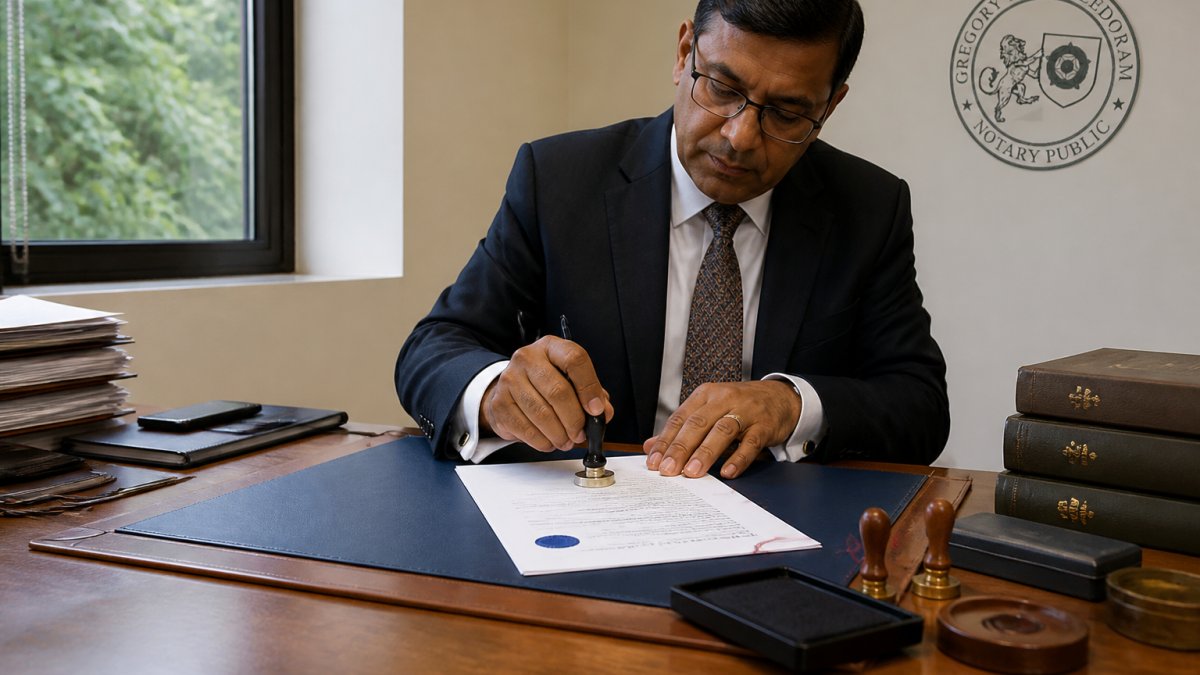
    Notary public sealing cross-border contracts in a London office during the document notarisation process
    Notary public sealing cross-border contracts in a London office during the document notarisation process

    A notary checks more than a signature, expect the notary to confirm:

    • The signatory is who they claim to be
    • The signatory has authority to bind the company
    • The company exists and is in good standing
    • Any power of attorney is valid and properly executed

    The document then receives a notarial certificate. This is the page foreign authorities actually read. If the wording is wrong, the rest of the chain collapses.

    This is where experience matters. A notary who understands commercial context will catch a resolution that does not actually authorise the signatory, or a certificate that names the wrong entity. Catching that early is far cheaper than catching it at the embassy.

    Step 3: Apostille Requirements for Commercial Contracts

    Apostille requirements for commercial contracts are met when the Foreign, Commonwealth & Development Office attaches an apostille certificate to a notarised document. The apostille confirms the notary’s signature and seal are genuine.

    The apostille itself does not prove the contract is valid. It proves the notary is real. That distinction trips people up constantly.

    Contact Gregory →

    The process runs like this:

    1. The document is notarised first
    2. The notarised document is submitted for an apostille
    3. The apostille is attached to the notarial certificate, not the contract
    4. The document is then ready for use in the destination country

    Apostilles work only between countries that have signed the Hague Apostille Convention. If the destination is not a member, you skip this step and go straight to consular legalisation.

    Step

    What Happens

    Who Acts

    Notarisation

    Signature and authority verified

    Notary public

    Apostille

    Notary’s seal authenticated

    FCDO

    Legalisation

    Embassy stamps the document

    Destination consulate

    Translation

    Certified translation added

    Sworn translator

    Key TakeawayThe apostille authenticates the notary, not the contract. If the destination questions the contract’s content, the apostille will not resolve it. That is a separate legal issue.

    Step 4: Legalisation of Documents for Overseas Use

    Legalisation of documents for overseas use is the final stage, where the destination country’s embassy or consulate stamps the document to confirm the apostille or notarial seal. It is required for countries outside the Hague Convention.

    This stage is slower and less predictable than the apostille. Consulates set their own timelines, fees, and document formats. Some accept walk-in submissions. Others require appointments weeks in advance or only accept postal applications.

    Common Mistakes When Legalising Cross-Border Contracts

    Mistakes cluster in predictable places. Fixing them before you file saves days.

    • Notarising after signing the wrong version. Always notarise the final, executed version.
    • Assuming an apostille is enough. Check whether the destination is in the Hague Convention.
    • Skipping the translation. Some registries reject untranslated documents outright.
    • Using a certificate with the wrong entity name. Match the legal name exactly.
    • Leaving legalisation to the last week. Consulate timelines are not negotiable.
    • Forgetting the signatory’s capacity. Authority must be proven, not assumed.

    The single biggest cause of rejection is a mismatch between what the destination asked for and what was submitted. That is a preparation failure, not a legal one.

    Watch OutDo not send original documents by standard post to an embassy, use recorded mail or a courier service. If they are lost, replacing a notarised and apostilled original can take weeks and may require re-execution of the contract.

    Conclusion

    Cross-border documentation rewards preparation and punishes improvisation. Confirm the destination’s rules, notarise correctly, apostille where required, and legalise through the right consulate in the right order.

    Gregory Mappledoram, Notary Public handles each stage including for time-pressured closings, more than 18 years of notarial practice, and a background of 25 years as a General Counsel. Documents are prepared to work in the destination jurisdiction, backed by professional indemnity and fidelity cover.

    Contact Gregory to get your international contracts notarised, apostilled, and legalised correctly the first time.

    Frequently Asked Questions

    Do cross-border contracts require an apostille?

    It depends on the destination country. If it is a signatory to the Hague Apostille Convention, an apostille issued by the Foreign, Commonwealth & Development Office (FCDO) is usually sufficient. For non-signatory states, you will need full consular legalisation through the relevant embassy or high commission. Always confirm the specific requirement with the receiving authority before instructing a notary, as telecoms regulators in some jurisdictions impose additional authentication steps.

    How does the Hague Convention affect contract legalisation?

    The Hague Apostille Convention replaces lengthy consular legalisation with a single apostille certificate for documents moving between member states. For cross-border contracts, this can cut processing time from weeks to days. However, some countries still require extra steps for commercial documents, so check the HCCH status table and the destination regulator’s guidance before assuming the apostille route applies.

    What is the role of a Notary Public in international commercial law?

    A Notary Public is an officer of the law authorised to verify signatures, certify document authenticity and witness executions for use abroad. In the context of cross-border contracts, the notary confirms the signatory’s identity and authority, certifies copies of board resolutions and company registers, and prepares the document for apostille or consular legalisation. Their seal and signature are what foreign authorities rely on to accept the document.

    Are there specific requirements for notarising technical service agreements?

    Technical service agreements often include schedules, annexes and technical specifications that also need certification. Ensure every page is accounted for and that any exhibits referenced in the contract are attached. Some jurisdictions require the notary to confirm the signatory’s corporate authority, so have board resolutions or a power of attorney ready. If the agreement is governed by foreign law, check whether the destination state requires a certified translation alongside the notarised original.

  • Notarised Power of Attorney for Property | London Notary

    Notarised Power of Attorney for Property | London Notary

    Table of Contents

    Last Updated: September 20, 2026

    What a Notarised Power of Attorney for Property Must Contain

    A notarised power of attorney for property is a legal instrument that lets someone you trust handle property matters on your behalf, with a Notary Public confirming that the signatures on it are genuine. This guide from Gregory Mappledoram Notary Public explains what the document needs, how to get it notarised, and where most applications go wrong.

    Every property power of attorney needs these core elements:

    • Grantor (the person giving authority) and attorney-in-fact (the person receiving it), named in full
    • A clear description of the property or the powers granted
    • The legal capacity of the grantor, confirmed at signing
    • Must be executed as a deed. This applies regardless of whether the document is intended for use in England or abroad. If it is executed in England, English law formalities govern its validity as a Power of Attorney (section 1(1) Powers of Attorney Act 1971). The Deed formalities are that it is in writing; states on the face of it that it is a deed, it is executed correctly depending on the legal personality of the donor, and it must be delivered.
    • A notarial certificate with the notary’s signature and notarial seal
    • Correct witnessing and due execution in line with the relevant rules

    Lasting Power of Attorney Property and Financial Affairs vs a Property POA

    A Lasting Power of Attorney property and financial affairs document and a property POA are not the same thing, and mixing them up causes real problems. An LPA is a statutory instrument registered with the Office of the Public Guardian. It covers financial decisions and stays valid if you lose mental capacity.

    Feature

    Lasting Power of Attorney

    Property POA

    Scope

    Broad financial affairs

    One property or transaction

    Registration

    Office of the Public Guardian

    Not usually registered

    Capacity

    Survives loss of capacity

    Usually ends with capacity

    Best for

    Long-term planning

    Single overseas or urgent deals

    Pro TipIf the property sits abroad, check whether the destination jurisdiction recognises an LPA before you rely on one. Many foreign land registries only accept a locally drafted deed.

    Step-by-Step: How to Get a Power of Attorney Document Notarised

    Getting a power of attorney document notarised follows three main stages: confirm the destination’s rules, prepare the deed (in compliance with local and English law requirements) and verify identity, then sign in front of the notary.

    Notary public guiding a client signing a notarized power of attorney deed at a desk
    Notary public guiding a client signing a notarized power of attorney deed at a desk

    Step 1: Confirm the Destination Jurisdiction’s Requirements

    The destination jurisdiction’s rules decide almost everything. A foreign jurisdiction may demand specific wording, a particular form of notarial certificate, or extra legalisation. Ask the receiving authority or your conveyancing solicitor what they need before you draft anything.

    Step 2: Prepare the Deed and Verify Identity

    Draft the deed to match those requirements. Ensure the deed is reviewed by the notary to confirm the English law formality requirements are met. Then gather proof of identity for everyone signing. Identity verification is a core part of the notary’s job, and a missing document can delay the whole appointment.

    Step 3: Attend the Notary Appointment and Sign

    Attend the appointment in person and sign in front of the notary. The notary checks legal capacity, ensures all English law formalities are satisfied, witnesses the signing, and attaches the notarial certificate. This confirms due execution so the document stands up abroad.

    Witnessing, Due Execution and the Notarial Certificate

    Witnessing and due execution are what make the document valid. The notary watches you sign, confirms you understand what you are signing, and records it in the notarial certificate. That certificate is the part foreign authorities read first.

    An Apostille for Power of Attorney: When It Is Needed

    An apostille for power of attorney is needed when the destination country is part of the Hague Apostille Convention. The apostille confirms the notary’s signature and seal are genuine, so the foreign authority can accept the document without further checks. In the UK, apostilles are issued by the Foreign, Commonwealth & Development Office (FCDO), which is the competent authority for England, Wales, Scotland and Northern Ireland.

    When an apostille is required

    An apostille is required when:

    • The destination country is a party to the Hague Apostille Convention, and
    • The receiving authority, a land registry, notary, court or bank, asks for one

    Most of the countries UK buyers and sellers deal with for property are Convention members, so an apostille is the normal route. The Hague Conference on Private International Law maintains the authoritative list of member states and any objections they have lodged.

    When legalisation is required instead

    If the destination is not part of the Convention, an apostille alone will not be accepted. You will need legalisation through the relevant embassy or consulate in addition to the apostille. That process typically involves:

    1. Notarisation of the deed by a Notary Public
    2. Submission to the FCDO for authentication of the notary’s signature and issuing the apostille
    3. Submission to the destination country’s embassy or consulate for their own legalisation stamp

    How to obtain an apostille in practice

    The standard route is:

    Contact Gregory →

    1. Have the deed notarised by a Notary Public.
    2. Send the original notarised document to the FCDO, either by post or through a solicitor or notarial service that handles the submission. Gregory Mappledoram Notary Public facilitates obtaining the apostille for all its clients as part of a holistic service.
    3. If you obtain the apostille yourself then you will need to pay the FCDO’s fee, which is set out on the government’s own guidance and is reviewed periodically. If the notary is obtaining the apostille for you then this will be included in the notarial service fee and you only have to pay the notary.
    4. Receive the apostilled document back, usually within a few working days by post or faster through a premium service.

    The apostille is attached to the notarised document, it is not a separate certificate you can carry around. If the document is later replaced or re-notarised, the apostille must be obtained again.

    Common pitfalls

    • Sending a photocopy instead of the original notarised deed, the FCDO will not apostille a copy.
    • Requesting an apostille before the notary has signed and sealed the deed.
    • Assuming an apostille is valid forever, it is not, and some receiving authorities expect it to be recent.
    • Forgetting that a certified translation may also need its own apostille or legalisation in some jurisdictions.
    Watch OutSending a document abroad without the right apostille or legalisation is the fastest way to have it rejected. The receiving authority will return it, and you start again, often after the transaction deadline has passed.

    How long it takes

    A straightforward FCDO apostille is typically turned around in a few working days by standard post, with a premium same-day or next-day service available for time-pressured transactions. Consular legalisation adds days or weeks depending on the embassy. If a property completion date is fixed, work backwards from that date and allow a buffer for translation and local registration.

    Notary Public Property Document Certification and Land Registry Registration

    Notary public property document certification is the step that turns a signed deed into a document a Land Registry will accept. A Notary Public is an internationally recognised public office, so their seal carries weight with foreign registries and courts. But certification and registration are two separate acts, and confusing them is a common source of delay.

    What certification actually involves

    When a Notary Public certifies a property power of attorney, they are not confirming that the contents are true. They are confirming:

    • The signer appeared in person before them
    • The signer was identified by acceptable evidence (typically a current passport or photocard driving licence, plus proof of address)
    • The signer appeared to understand the document and signed voluntarily
    • The signature on the deed matches the signature the notary witnessed

    How registration works at the receiving end

    Registration is a separate step carried out by the destination jurisdiction’s land registry, not by the notary. The pattern most practitioners see is:

    1. The POA is notarised in the country of signing.
    2. It is apostilled or legalised (see the next section).
    3. It is sent to the destination jurisdiction, often with a certified translation if the registry does not operate in English.
    4. The receiving registry, or, in some jurisdictions, a local notary or solicitor, registers the POA so it can be cited in the property transaction.
    5. The registered POA is then used to sign the transfer, charge, or lease.

    What the receiving registry typically asks for

    A common pattern is that the registry wants:

    • The original notarised deed, not a scan
    • The apostille or legalisation certificate attached to it
    • A certified translation into the local language
    • Evidence of the grantor’s identity and, sometimes, their signature
    • A local registration fee, which varies by jurisdiction
    Pro TipIf the property sits in a jurisdiction that requires local registration, ask your conveyancing solicitor to confirm the exact sequence, notarisation, apostille, translation, registration, before you book the notary appointment. Doing the steps out of order is one of the most common causes of a returned document.

    Where the Land Registry fits in

    Where the property is registered domestically, the Land Registry may need to see the POA if it is being used to sign a transfer or charge. The registry will check that the POA was validly executed and, where required, that it was registered in the correct form. A certified copy of the original is often acceptable for the registry’s file, but the original notarised deed should be retained by the grantor or their solicitor.

    Common Rejection Reasons and the POA Revocation Process

    Rejections usually trace back to a handful of fixable problems. Knowing them in advance saves weeks of back-and-forth.

    • Wrong or missing apostille or legalization
    • A notarial certificate that omits key details
    • Signatures that were not witnessed properly
    • A deed that does not match the destination’s required wording
    • An expired or revoked authority
    Key TakeawayMost rejections come down to preparation, not bad luck. Confirm the destination’s rules first, discuss the document and the process with the notary, and the rest of the process runs smoothly. Further details can be found on Visiting a Notary or the Services pages.

    Frequently Asked Questions

    Does a power of attorney for property need to be notarised?

    It depends on where the document will be used. For a property transaction inside England and Wales, a power of attorney deed normally only needs to be witnessed, not notarised. A notarized power of attorney for property becomes necessary when the document is sent to a foreign jurisdiction, when a Land Registry application is queried, or when a bank or overseas authority demands proof that the signature is genuine. Always confirm the destination’s requirements before signing.

    How do I get a power of attorney document notarised?

    First confirm what the receiving jurisdiction needs, including whether an apostille or consular legalisation is required. Prepare the power of attorney deed (or request the notary to assist you with the drafting of the deed), gather original identification and proof of address, and book an appointment with a notary public. You sign in the notary’s presence, the notary verifies identity and legal capacity, witnesses due execution and attaches a notarial certificate. If an apostille is needed, the notary can usually arrange it.

    When is an apostille for power of attorney required?

    An apostille is required when the destination country is a party to the Hague Apostille Convention and its authorities will not accept a notarial certificate alone. It is issued by the Foreign, Commonwealth & Development Office and confirms the notary’s signature and seal are genuine. Countries outside the Convention usually need consular legalisation instead. Confirm the specific requirement for the destination before the appointment, as getting this wrong is a common cause of rejection.

    Can a notarised power of attorney be rejected abroad, and why?

    Yes. The most common rejection reasons are a missing or incorrectly worded notarial certificate, an apostille attached to the wrong document, a stale or undated POA, a signature that does not match the specimen on file, and wording that does not match the destination’s statutory requirements. Some authorities also reject documents where the notary’s authority is not evidenced. Checking the destination’s checklist before signing prevents most of these problems.

  • How to Notarise Foreign Company Registers Abroad | London Notary

    How to Notarise Foreign Company Registers Abroad | London Notary

    Table of Contents

    Last Updated: September 16, 2026

    What You’ll Need Before You Start

    Knowing how to notarise foreign company registers is the process of having a notary public verify and certify corporate documents so they are accepted by authorities in another jurisdiction. Getting it wrong means rejected filings, missed deadlines, and delayed transactions.

    Most rejections trace back to preparation, not the notary. Before you book an appointment, assemble the following:

    • The full register of members and register of directors in their original form
    • Certificate of incorporation and any certificate of incumbency or good standing
    • Board resolutions authorising the transaction or filing
    • Valid photo identification for every signatory
    • The destination authority’s written requirements, if you have them
    Watch OutAttending your appointment without the destination authority’s requirements in writing is the single most common cause of rejection. If the receiving body specifies a particular wording, process, or certification chain, the notary cannot guess it.

    Step 1: Confirm How to Notarise Company Registers for the Destination Country

    The first step is confirming exactly what the receiving authority expects, because requirements differ by jurisdiction. Some countries accept a notarised copy with an apostille; others demand full consular legalisation.

    For cross-border business filings, the Hague Conference on Private International Law guidance on the Apostille Convention sets out which states accept an apostille in place of consular legalisation. Check the destination against that list before anything else.

    Documents typically required

    • Register of members (shareholder certification)
    • Register of directors and company extract
    • Certificate of incorporation
    • Certificate of incumbency or good standing
    • Board resolutions and corporate authority documents
    • Sworn statement, declaration or affidavit where the destination requires one

    Ask the receiving authority two questions: which documents, and which certification route. Their answer determines everything that follows.

    Step 2: Apostille Requirements for Corporate Registers

    An apostille is a certificate issued by a competent authority that authenticates the signature and seal of the notary, so the document can be used in another signatory country. In the UK, the competent authority is the Foreign, Commonwealth & Development Office (FCDO).

    The FCDO guidance on legalisation and apostilles confirms that the FCDO legalises UK public documents and notarised documents for use overseas. The chain matters: the notary certifies the document first, then the FCDO attaches the apostille.

    Deciding whether you need an apostille at all

    Before booking anything, establish which of three routes your destination requires. This is the single decision that determines cost, timeline, and whether your filing succeeds.

    Destination status

    Route required

    What the receiving authority accepts

    Hague Apostille Convention signatory

    Notary → FCDO apostille

    Apostilled notarised document

    Hague signatory with an objection or reservation to UK documents

    Notary → FCDO apostille → consular legalisation

    Full chain

    Non-signatory state

    Notary → FCDO apostille → consular legalisation

    Full chain, consulate authenticates the FCDO mark

    What the FCDO will and will not legalise

    The FCDO legalises the signature and seal of an English notary on a document intended for overseas use. It does not:

    • Certify that the contents of the register are accurate
    • Confirm the signatory’s authority to bind the company
    • Translate the document
    • Advise on whether the destination will accept the result

    If your register is a certified copy rather than an original, the notary’s certificate must state clearly what was certified and against what. The FCDO will reject a notarial certificate that is ambiguous about the underlying document.

    When an apostille is not enough

    An apostille only works between countries that are party to the Hague Convention and have not filed an objection. If the destination is not a signatory, or has filed an objection, you need consular legalisation in addition to the apostille. Some countries also require translation before, not after, legalisation.

    Pro TipIf your destination is not a Hague Convention signatory, plan for consular legalisation from the outset. The FCDO apostille will not be accepted, and starting the consular route late can add days to a time-pressured filing.

    The digital-first question

    Electronic apostilles (e-APP) and remote online notarisation are increasingly recognised, but acceptance is uneven. Some receiving authorities will accept an electronically issued apostille; others still insist on a physical seal. If your transaction is time-critical and the destination is known to be conservative on format, confirm in writing whether an electronic apostille will be accepted before you rely on it. Do not assume that because the FCDO can issue electronically, the receiving registry will accept electronically.

    Step 3: Notarising Company Documents for Use Abroad

    Understanding how to notarize foreign company registers for use abroad means the notary verifies the signatory’s identity, confirms the document’s authenticity, and applies a notarial certificate and seal. The notary does not certify that the contents are true, only that the execution and copies are genuine.

    Notary public examining corporate registers with a seal and stamp to show how to notarize foreign company registers
    Notary public examining corporate registers with a seal and stamp to show how to notarize foreign company registers

    The company representative must attend in person with original documents and identification, whether the appointment is at the Notary’s office or the company office.

    Step 4: Legalisation of Foreign Business Documents at the Consulate

    Legalisation of foreign business documents is the step after notarisation, where the destination country’s consulate or embassy confirms the notary’s and FCDO’s marks are genuine. It is required for non-Hague destinations and for some signatories with additional conditions.

    How consular legalisation actually works

    The consulate is not re-examining your company register. It is verifying that the FCDO apostille is genuine and that the notarial certificate beneath it is properly executed. In practice the consular officer checks:

    • That the apostille is attached to the correct document and has not been detached or altered
    • That the notary’s name and seal match the FCDO’s record
    • That the document class is one the consulate is authorised to legalise
    • That any required translation is certified and, where demanded, itself notarised

    Consular conditions that catch people out

    Beyond the basic chain, individual missions impose their own requirements. Common patterns include:

    • Appointment-only submission. Many consulates no longer accept walk-in legalisation and require a booked slot, sometimes weeks ahead. Some missions like the UAE only accept postal applications with 2 week turnaround times – so plan accordingly.
    • Approved translator lists. Some missions only accept translations from translators on their own register, which means a perfectly good certified translation can still be rejected.
    • Additional notarisation of the translation. A number of consulates require the translator’s certification to be separately notarised, adding a second notarial act to the chain.
    • Validity windows. Some legalisations are only accepted by the receiving registry for a limited period, so timing the consular step against the filing deadline matters.
    • Payment method restrictions. Consular fees are frequently payable only by a specified method, and an incorrect payment can delay the whole submission.
    Watch OutDo not commission a translation until you have confirmed whether the destination consulate maintains an approved translator list. A certified translation from an unlisted translator is a common and entirely avoidable cause of rejection at this stage.

    Planning the timeline

    Consular legalisation is usually the longest single step in the chain, and it sits at the end, which makes it the most dangerous for deadline-driven filings. A practical approach is to work backwards from the filing date:

    1. Confirm the destination’s route and any consular conditions in writing
    2. Book the notary appointment, allowing time for any translation to be prepared first
    3. Submit to the FCDO for the apostille
    4. Book the consular appointment as soon as the apostille is issued, not before
    5. Allow a buffer for a returned document, because a single correction restarts the consular clock
    6. Gregory Mappledoram, Notary Public provides a one stop service where the FCDO apostille and any consular legalisations are included in the notarial service provided, thereby eliminating the administrative burden of the company doing it all.
    Key TakeawayThe document chain must be completed in order: notary, apostille, consulate. Any gap invalidates the certification, regardless of how well each individual step was executed. Consular conditions, appointments, translator lists, payment methods, are where otherwise-correct chains most often stall. Further information can be found on the Services and Apostille pages.

    Step 5: Handling Non-English Documents and Certified Translations

    Non-English documents need a certified translation before legalisation, and the order matters. Many authorities require the translator’s certification to be notarised alongside the original.

    Common Mistakes That Cause Rejection

    Rejections cluster around a handful of avoidable errors. Watch for these:

    Mistake

    Why it fails

    The fix

    Wrong certification route

    Apostille used where consular legalisation is required

    Confirm Hague status before booking

    Missing document chain link

    Notarised but not legalised, or vice versa

    Complete notary, apostille, consulate in order

    Translation after legalisation

    Translation not covered by the apostille

    Translate before notarising

    Copies instead of originals

    Notary cannot certify an unverified copy

    Bring originals and identification

    No written requirements

    Notary cannot match the destination’s wording

    Obtain the authority’s requirements in writing


    Frequently Asked Questions

    Do I need an apostille for foreign company registers?

    It depends on the destination country. If that country is a signatory to the Hague Convention, an apostille issued by the Foreign, Commonwealth & Development Office is usually sufficient. If it is not, you will also need consular legalisation. Always confirm the exact requirement with the receiving authority, your bank, or the relevant embassy before you start, because a rejected document costs both time and money.

    Can a Notary Public certify foreign company registers?

    Yes. A Notary Public can certify a true copy of a company register, witness a sworn statement, and verify the identity of directors or shareholders. The notary will check that the document is genuine, that the signatory has authority to sign, and that the certification meets the format expected by the destination jurisdiction. For non-Hague countries, the notarised document then goes through the FCDO and the relevant consulate.

    What documents are required for international corporate notarisation?

    Typically you will need the original or a certified copy of the register of members or register of directors, a certificate of incorporation, current proof of the signatory’s identity (passport and proof of address), and any board resolution authorising the transaction. If the documents are not in English, a certified translation is usually required. The exact list depends on the foreign jurisdiction and the receiving body, so confirm their requirements first.

    How does the Hague Convention affect document notarisation?

    The Hague Apostille Convention simplifies the process between signatory countries by replacing consular legalisation with a single apostille certificate. For company registers going to a signatory country, the notary certifies the document and the FCDO attaches the apostille. For non-signatory countries, the document must be legalised by the destination country’s consulate after FCDO certification, which adds time and cost to the process.

  • Legalising Documents for International Mergers | Notary

    Legalising Documents for International Mergers | Notary

    Table of Contents

    Last Updated: September 14, 2026

    Why International Mergers Need Legalised Documents

    When two companies from different countries combine, the paperwork does not travel on trust. Legalising documents for international mergers is the process of confirming that a signature, seal or certified copy is genuine so a foreign registry, court or regulator will accept it. Without that confirmation, a filing stalls at the first desk it reaches.

    The stakes are straightforward. A merger completion can hinge on whether a certificate of incorporation or a board resolution is accepted in the destination jurisdiction, and different countries demand different routes. This guide from Gregory Mappledoram Notary Public, sets out the practical steps: choosing between an apostille and consular legalisation, preparing the right documents, and avoiding the rejections that delay closings.

    Below, we show you exactly how to move a merger document set from a boardroom to a foreign filing office without the back-and-forth that trips up most teams.

    Apostille or Consular Legalisation? Matching the Route to the Jurisdiction

    The route depends entirely on whether the destination country is a party to the 1961 Hague Convention (HCCH | #12). An apostille is a single certificate that authenticates a public document for use in another Convention country. Consular legalisation is the longer chain used for countries outside the Convention, where a consulate or embassy adds its own verification.

    The two are not interchangeable, and choosing the wrong one is the most common reason a filing is returned. If the destination is a Convention member, an apostille is normally sufficient. If it is not, the document usually needs the full chain: notarisation, then authentication, then consular legalisation by the destination’s diplomatic mission.

    Route

    Used For

    Typical Chain

    Relative Speed

    Apostille

    Convention member countries

    Notary → competent authority

    Faster

    Consular legalisation

    Non-Convention countries

    Notary → competent authority → consulate or embassy

    Slower

    Watch OutA document apostilled for one country cannot be reused for a non-Convention country. Filing the wrong route wastes the notarisation and can push a closing date back by weeks.

    Documents Usually Required for Cross-Border Merger Filings

    Merger filings draw on a predictable set of corporate documents, but the order in which they are prepared matters as much as the list itself. A certificate of incorporation can be apostilled in days; a board resolution that has not yet been signed cannot be notarised at all. Mapping the sequence before the first notarial appointment is what separates a clean filing from a closing date that slips.

    The table below sets out the documents most cross-border transactions require, what the notary is actually certifying, and the legalisation route each document normally takes.

    Document

    What the notary certifies

    Typical legalisation route

    Certificate of incorporation

    Certified copy of the public record

    Apostille or consular legalisation

    Certificate of good standing

    Certified copy of the registrar’s certificate

    Apostille or consular legalisation

    Articles of association

    Certified copy of the filed articles

    Apostille or consular legalisation

    Board resolutions approving the merger

    Genuineness of signatures and signatory identity

    Notarisation, then apostille or consular legalisation

    Powers of attorney for signing officers

    Genuineness of signatures and authority

    Notarisation, then apostille or consular legalisation

    Certified copies of company registers

    Certified copy of the register extract

    Apostille or consular legalisation

    Shareholder resolutions (where required)

    Genuineness of signatures and signatory identity

    Notarisation, then apostille or consular legalisation

    Each document must be either an original or a certified copy, and any document in a foreign language typically needs a sworn translation. The destination authority decides which of these it will accept and in what form, so confirm the list before notarisation begins.

    The merger document workflow, in sequence

    Most practitioners follow a fixed sequence, because each stage depends on the one before it:

    Contact Gregory →

    1. Confirm the destination’s requirements. Establish whether the destination is a Convention country, which documents it will accept, and whether it requires sworn translation or additional certified copies.
    2. Finalise the underlying documents. Board and shareholder resolutions must be in final form and signed before any notarial appointment. Amendments after signing invalidate the certification.
    3. Notarise the documents that carry private signatures. Resolutions, powers of attorney and register extracts are notarised first. Public documents such as the certificate of incorporation are notarised as certified copies from documents filed with Companies House.
    4. Obtain the apostille or FCDO authentication. Public documents and notarised instruments both pass through the competent authority for the destination route.
    5. Consular legalisation, where required. Non-Convention destinations add a consular or embassy seal after authentication.
    6. Sworn translation, where required. Translation is normally arranged after legalisation so the translator can certify the final, sealed document.
    7. File with the destination registry, court or regulator. Check the apostille or consular certificate for errors before filing, because a defect at this stage restarts the chain.

    Documents that catch teams out

    Two categories cause disproportionate delay. The first is documents that look public but are not: a certificate of good standing issued by a registrar is a public document, but a letter from the company secretary confirming good standing is a private document and needs notarisation before it can be apostilled. The second is documents that must be signed in front of the notary rather than pre-signed, which some destinations require for powers of attorney.

    Pro TipBuild the document list backwards from the destination registry’s filing checklist, not forwards from your own corporate records. Registries reject document sets that are complete on the company’s side but incomplete against the registry’s own list.

    Once the list and the sequence are fixed, the notarial appointment becomes a single, predictable step rather than the first of several rounds of correction.

    Notarising Board Resolutions for Mergers: What to Prepare

    Board resolutions are where merger document sets most often fail. A notary public can confirm that the signatures on a resolution are genuine and that the signatories are who they claim to be, but the notary cannot certify that the meeting itself was validly held. That distinction matters, and foreign registries know it.

    Before the appointment, prepare the following:

    • The final, signed resolution, not a draft
    • Evidence of each signatory’s identity
    • Confirmation of each signatory’s authority to bind the company
    • The company’s articles of association, in case the registry queries signing powers

    A common mistake is presenting a resolution that has been amended after signing.

    Using the FCDO Apostille Service: Step by Step

    Pro TipThe FCDO rejects documents where the notarial certificate is incomplete or the signature does not match its records. Have your notary check the certificate wording against the destination’s requirements before submission, not after.

    The Consular Legalisation Process for Non-Convention Jurisdictions

    Which route applies: a country matrix

    Destination category

    Typical route

    What the chain looks like

    Convention member states

    Apostille

    Notary or certified copy, then FCDO apostille

    Non-Convention states with a London mission

    Full consular legalisation

    Notary, FCDO authentication, then consular seal

    Non-Convention states without a London mission

    Full consular legalisation via a third mission

    Notary, FCDO authentication, then legalisation by a mission covering the destination

    Destinations requiring additional translation

    Apostille or consular legalisation plus sworn translation

    Legalisation first, then certified translation

    How consulates differ in practice

    Watch OutA document apostilled for one country cannot be reused for a non-Convention country, and a consular legalisation is specific to the destination mission. Filing the wrong route wastes the notarisation and can push a closing date back by weeks.

    Planning the timeline

    Key TakeawayThe route is determined by the destination, not by preference. Confirm the destination’s Convention status and the relevant mission’s requirements first, then build the notarisation, authentication and legalisation chain around that answer. Some embassies only accept postal submissions (which can take 1-2 weeks for processing) and others allow agents to process the same or next business day.

    Common Rejection Reasons and How to Avoid Them

    Rejection Reason

    Why It Happens

    How to Avoid It

    Wrong route used

    Apostille sent to a non-Convention country

    Confirm Convention status first

    Incomplete document

    Wording missing a required element

    Have the notary check against local and destination rules

    Unsigned or amended resolution

    Document changed after notarisation

    Finalise, sign once, notarise immediately

    Poor-quality certified copy

    Blurred or partial seal

    Use a clean, complete copy

    Missing sworn translation

    Foreign-language document filed untranslated

    Arrange translation before filing

    Key TakeawayMost rejections trace back to one cause: the document was certified before the destination’s requirements were confirmed. Verify the rules first, then notarise. Further information can be found on the Services pages.

    Conclusion

    Frequently Asked Questions

    What documents are typically required for international mergers?

    Most cross-border filings need a certificate of incorporation, certificate of good standing, articles of association, board resolutions approving the transaction, and a certified copy of the company register. Powers of attorney for signing parties are often requested too. The exact list depends on the destination jurisdiction and its registry, so confirm the requirements with local counsel before you start notarising board resolutions for mergers or sending anything for legalisation.

    What is the difference between an apostille and legalisation?

    An apostille is a single certificate issued under the 1961 Hague Convention that confirms the authenticity of a public document’s signature, seal or stamp. Legalisation, sometimes called consular legalisation, is the longer chain required by countries outside the Convention: the document goes through the Foreign, Commonwealth & Development Office and then the destination country’s diplomatic mission or consulate. Apostilles are faster and cheaper; legalisation takes longer and costs more.

    Can a document be apostilled without being notarised?

    It depends on the document. Some public documents, such as certain certificates issued directly by a government body, can go straight to the FCDO for an apostille. Company documents signed by directors, powers of attorney and certified copies usually need notarisation first, because the FCDO is verifying a notary public’s signature and seal rather than a private individual’s. Check the specific document type before booking anything.

    How long does the document legalisation process take?

    Timescales vary by route. The FCDO apostille service offers standard and faster turnaround options, and consular legalisation adds further time because each diplomatic mission sets its own processing window and appointment rules. For a time-pressured merger, start the notarisation stage as early as possible and build in buffer for translation and courier transit. Your notary or legal adviser can confirm current published timescales for your destination.