Table of Contents
- Notarising Board Resolutions for Foreign Use: What the Process Involves
- What a Notary Actually Certifies
- What You’ll Need Before the Appointment
- Board Resolution Certification: What the Notary Certifies and Why It Matters
- Notarising Company Documents: Beyond the Board Resolution
- The Apostille for Board Resolution: When It’s Required
- How Long to Notarise a Board Resolution
- Common Mistakes That Get Board Resolutions Rejected Abroad
- Conclusion
- Frequently Asked Questions
Last Updated: 8 October 2026
Notarising Board Resolutions for Foreign Use: What the Process Involves
Notarising board resolutions for foreign use is the process of having a qualified notary verify the signatures and authority behind a company’s board decision so that overseas authorities will accept the document. When a UK company needs to open a bank account abroad, complete a cross-border deal, or register a subsidiary in another country, the receiving authority often will not accept a resolution signed only by company officers. It wants independent verification. That is where a notary comes in.
This guide from Gregory Mappledoram Notary Public walks through what a notary actually certifies, what to bring, and how to avoid rejections. Gregory Mappledoram has spent over 18 years in notarial practice, and the most common delays come down to preparation, not the law itself.
Below, we break down each stage so your documents arrive ready for the destination jurisdiction.
What a Notary Actually Certifies
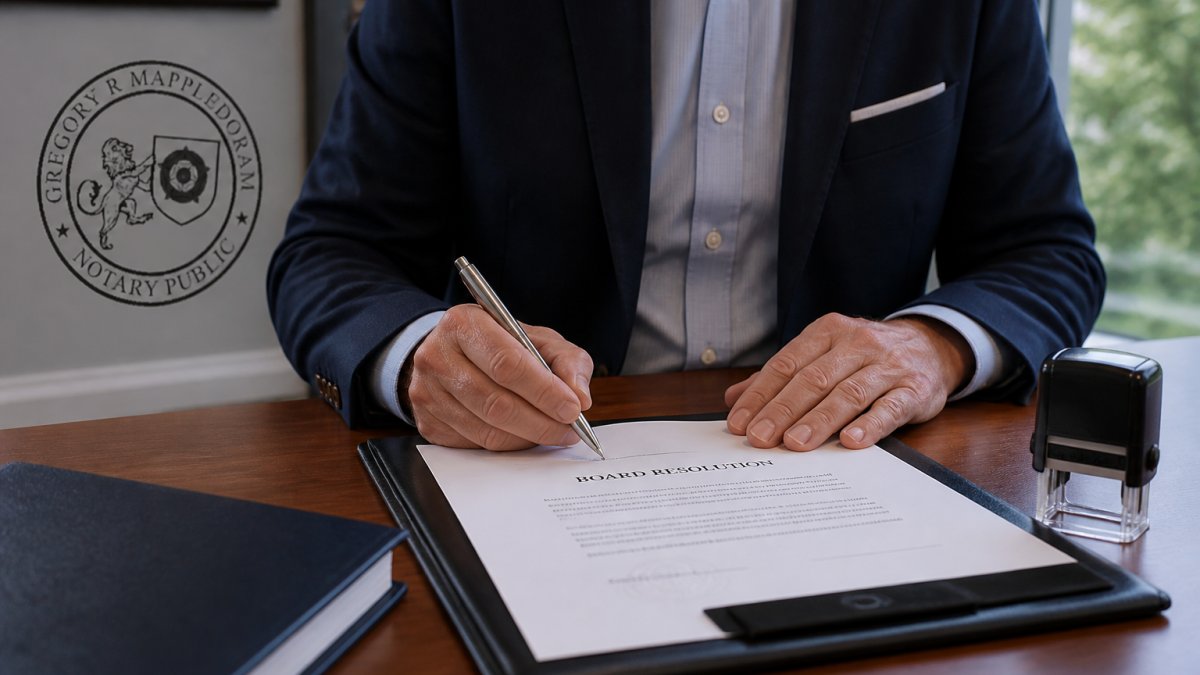
A notary certifies identity, signature, and authority. The notary does not certify that the board’s decision is commercially sound or legally perfect in the target country.
Here is what the notary confirms:
- The person signing is who they claim to be
- The signature was made freely and in the notary’s presence
- The signatory holds the position the resolution states
- The document itself is properly executed
The notary’s role is verification, not legal advice on the deal. The Faculty Office notarial guidance sets out the standards notaries in England and Wales must meet.
What You’ll Need Before the Appointment
Preparation decides how quickly this moves. Missing documents are the main reason appointments get rescheduled.
Documents to Bring
Bring the following to your appointment:
- The original board resolution, signed by the required directors
- Proof of identity for each signatory (passport or driving licence)
- Proof of the signatory’s position, such as a company register extract
- The company’s certificate of incorporation
- Any instructions from the receiving authority abroad
- A covering letter if the destination country requires one
Check the exact wording the foreign authority expects before you attend. Some jurisdictions want specific wording on the notarial certificate.

Board Resolution Certification: What the Notary Certifies and Why It Matters
Board resolution certification matters because foreign authorities treat an uncertified resolution as unverified. The certification is what turns a private company document into one another country will act on.
The notary attaches a certificate confirming the signatory’s identity and authority. This certificate is the part the overseas body reads first. If the wording is wrong, the whole document can be refused even when the resolution itself is fine.
A common mistake is assuming the notary certificate and the apostille are the same thing. They are not.
|
Stage |
Who Provides It |
What It Confirms |
|---|---|---|
|
Notarial certificate |
The notary |
Identity, signature, authority |
|
Apostille |
The FCDO |
Authenticity of the notary’s signature |
|
Consular legalisation |
The destination embassy |
Acceptance in that country |
The notary certificate comes first. Everything else builds on it.
Notarising Company Documents: Beyond the Board Resolution
Notarising company documents often covers more than one item. A foreign bank or registry may ask for several documents at once, and handling them together saves time.
Documents we commonly see alongside a resolution:
- Powers of attorney for overseas transactions
- Certificates of good standing
- Company register extracts
- Director and shareholder resolutions
- Certified copies of incorporation documents
Each document may need its own certification. Grouping them into one appointment keeps the wording consistent across the pack.
The Apostille for Board Resolution: When It’s Required
An apostille for a board resolution is required when the destination country is part of the Hague Apostille Convention. The apostille confirms the notary’s signature is genuine, so the foreign authority can trust the document.
The Hague Conference on Private International Law maintains the list of member countries. If your destination is a member, an apostille is usually enough. If it is not, you may need consular legalisation from that country’s embassy instead.
In the UK, the Foreign, Commonwealth & Development Office issues apostilles. The notary prepares the document; the FCDO then attaches the apostille. These are two separate steps, and both take time.
So before booking anything, confirm which route your destination needs.
How Long to Notarise a Board Resolution
How long to notarise a board resolution depends on the document and the route. The notarial appointment itself is often quick once the paperwork is ready.
Typical timing:
- Notarial certification: usually same day when documents are complete
- Apostille from the FCDO: allow several working days
- Consular legalisation: longer, and it varies by embassy
The appointment is rarely the bottleneck. Waiting on the apostille or an embassy is. If you have a closing deadline, work backwards from the date the foreign authority needs the document, not the date of your meeting.
At Gregory Mappledoram Notary Public, same-day notarial service is available for time-pressured transactions, so the notarial stage need not add delay. The rest of the timeline sits with the FCDO or the embassy.
Common Mistakes That Get Board Resolutions Rejected Abroad
Most rejections trace back to avoidable errors. The resolution may be perfectly valid in the UK and still fail overseas.
The usual culprits:
- Signing before the appointment instead of in the notary’s presence
- Using certificate wording the destination country does not accept
- Missing proof of the signatory’s authority
- Skipping the apostille when the country requires one
- Sending copies when originals are required
- Names or dates that do not match across documents
Each of these is fixable before you attend. The cost of fixing them afterwards is a rejected filing and lost time.
Documents are prepared to work in the destination jurisdiction, which is why checking the receiving authority’s requirements first matters more than speed alone. If you are unsure what a specific country needs, raise it before the appointment rather than after.
Conclusion
Cross-border filings fail on detail, not on the strength of the board’s decision. Getting the wording, authority evidence, and legalisation route right the first time is what keeps a deal on schedule. Gregory Mappledoram offers same-day notarial appointments, over 18 years of notarial experience, and a background in international commercial law that helps match documents to the destination jurisdiction. We also carry professional indemnity and fidelity cover for added protection. Contact Gregory to get your board resolutions certified and ready for filing abroad.
Frequently Asked Questions
How do you notarise a board resolution for use abroad?
The signatory attends a notary in person with valid photo ID and the original resolution. The notary verifies identity, witnesses the signature, and attaches a notarial certificate confirming the signatory’s authority. If the destination country is not party to the Hague Apostille Convention, the document then goes through consular legalisation. The notary should be told the destination jurisdiction in advance so the certificate wording is correct.
Does a board resolution need an apostille for foreign use?
It depends on the destination country. If the country is a party to the Hague Apostille Convention, an apostille from the Foreign, Commonwealth & Development Office is usually sufficient. If it is not, consular legalisation through the destination country’s embassy or consulate is also required. Confirm the requirement with the receiving authority before instructing a notary.
Who can sign a board resolution before a notary?
The person who signed the resolution, typically a director or the company secretary, must attend the notary in person. The notary will check that the signatory is named in the resolution and has authority under the company’s articles of association. If a third party signs under a power of attorney, that power must also be produced and may itself need notarising.
How long does it take to notarise and apostille a board resolution?
Notarisation itself is usually completed in a single appointment. The apostille stage depends on FCDO processing times, which vary but typically 2-4 business days. If consular legalisation is also required, add further time for embassy or consulate handling. For time-pressured transactions, tell the notary the deadline upfront so the sequence can be planned around it.