
Last Updated: October 27, 2026
Quick Summary
Notarisation costs are the total fees charged to certify a document for use abroad, combining the notary’s fee, any apostille or consular legalisation charges, translation costs and courier expenses. Each element responds to a different trigger, so the document type and destination country shape the bulk of the price.
- The destination country’s rules often matter more than the document’s content when pricing notarisation.
- A document must be notarised before it can be legalised by apostille or consular legalisation.
- The FCDO fee does not cover the notary’s fee, translation, courier costs or consular legalisation.
- Confirm the destination’s requirements before instructing anyone, as rejected documents cost more than fees saved.
- Ask providers to break out notary, legalisation, translation and delivery fees separately in writing.
Table of Contents
- What Drives Notarisation Costs for International Documents
- The International Document Legalisation Process Explained
- Apostille Cost: What the FCDO Fee Covers
- Document Legalisation Fees Beyond the Apostille
- When an Urgent Notary Service Is Worth the Extra
- How to Keep Notarisation Costs Down Without Cutting Corners
- Getting a Clear Quote for Your Documents
- Frequently Asked Questions
What Drives Notarisation Costs for International Documents
The costs of international document notarisation rarely come down to a single fee. They reflect the document itself, the destination country’s rules, and how quickly you need the work done. Understanding what sits behind that number is the first step to controlling it.
Notarisation costs are the total fees charged to certify a document for use abroad. They combine the notary’s own fee, any apostille or consular legalisation charges. In addition to this there may be translation costs and courier expenses. Each element responds to a different trigger.
Two factors shape the bulk of the price: what the document is, and where it is going.
Document type and complexity
Complexity shows up in several ways:
- The number of signatories who must be verified
- Whether the notary must witness a signature in person
- How many pages need certification
- Whether supporting evidence of identity or authority is required
Destination jurisdiction requirements
Where a document is heading often matters more than what it says. Some countries accept a simple notarial certificate. Others demand an apostille, or full consular legalisation. A few require certified translation into the local language before submitting.
The destination drives the chain of steps. A document bound for a country that is part of the Hague Apostille Convention may need only an apostille (HCCH). One heading to a non-member state could need full consular legalisation.
Confirm the destination’s requirements before instructing anyone. Our guide to legalisation requirements for foreign jurisdictions sets out what different countries ask for.
The total cost of notarising a document for use abroad is made up of several separate elements.
Cost element | What it covers |
|---|---|
Notary’s fee | Preparing and certifying the document |
Apostille or consular legalisation | Official certification for the destination country |
Translation | Rendering the document into the local language |
Courier expenses | Delivery of documents |
The International Document Legalisation Process Explained
The international document legalisation process is the sequence of steps that makes a notarised document acceptable to authorities in another country. It typically runs from notarisation, through an apostille or consular legalisation, certified translation where required, to delivery in the destination state.
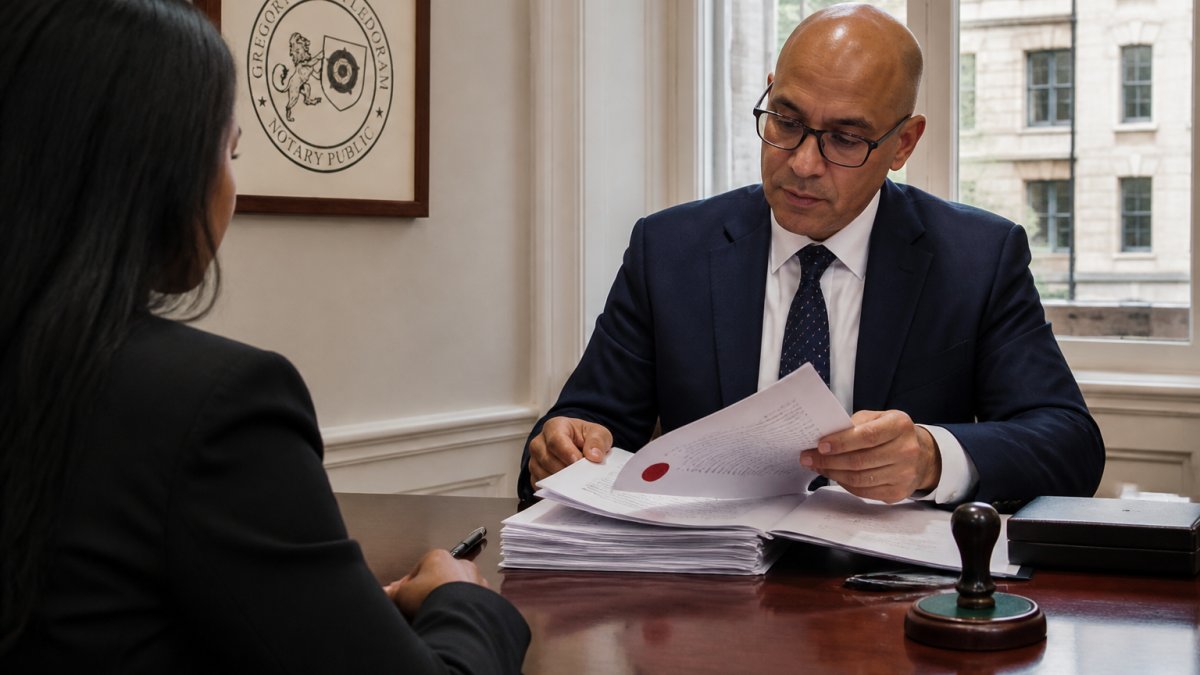
The order matters. A document must be notarised before it can be legalised. Our apostille and legalisation service explains the next step and how to book it.
Here is how the process usually unfolds:
Apostille Cost: What the FCDO Fee Covers
What the FCDO fee does not cover:
- The notary’s fee for preparing and certifying the document
- Translation into another language
- Courier or postage costs
- Consular legalisation where an apostille is not enough
Document Legalisation Fees Beyond the Apostille
A simple way to think about it: the notary fee is one line, and legalisation, translation, and delivery are the others. Ask any provider to break these out separately so you can see what you are paying for. The notary is not responsible for issuing the apostille, this is the function of the FCDO, but the notary can assist with obtaining the apostille for clients.
When an Urgent Notary Service Is Worth the Extra
You can contact Gregory Mappledoram, Notary Public to discuss what is achievable for your deadline.
How to Keep Notarisation Costs Down Without Cutting Corners
Cutting costs is fine. Cutting corners is not, because a rejected document costs more than the fee you saved. The trick is to remove waste, not accuracy.
A few practical moves help:
- Confirm requirements first. Check what the destination actually needs before instructing anyone.
- Speak to the Notary as soon as possible for timelines and any specific notarial requirements.
- Work backwards from the deadline. Once you have the deadline and specific requirements work backwards on the timing to ensure everything can be completed on time.
A common mistake is assuming every country needs the same treatment. They do not.
Getting a Clear Quote for Your Documents
You can review our fee guide at https://notary.uk.com/fees/ to see how fees are structured and request a quote before instructing.
Ask questions, check the destination rules, and get the fee in writing.
Frequently Asked Questions
How much does it cost to notarise a document for use abroad?
There is no single figure. Pricing depends on the documents and the work required. Contact Gregory for current pricing or a quote.
Is an apostille included in a notary’s fee?
Whether an apostille is included depends on the services arranged. Contact Gregory to confirm what is included in a quote. Gregory does not issue the apostille, the FCDO does, but Gregory can assist in obtaining the apostille for clients, as well as assisting in obtaining any consular legalisation.
Can translation increase the cost of preparing a document for overseas use?
Translation may affect the overall cost. Check the destination authority’s requirements. The translation service is the last step in the process.
Can a notary charge extra for urgent or same-day service?
Pricing for urgent work is not specified here. Contact Gregory to ask about current pricing and what may be achievable for your deadline.
Getting a document rejected abroad is a costly headache. Gregory Mappledoram brings over 18 years of notarial experience and 25 years as a General Counsel to every instruction, with same-day appointments available for time-pressured matters. Documents are prepared to work in the destination jurisdiction, and you are protected through professional indemnity and fidelity cover. Get started with Gregory and secure a fixed fee before your work begins.
