
Last Updated: 4 November 2026
Quick Summary
A UK power of attorney is not automatically valid abroad, because recognition is decided by the law of the country and the institution reviewing it. Some foreign banks or offices accept an English Lasting Power of Attorney after checking it, while others refuse it and ask for a local document instead. Confirm the requirements with the receiving body before you rely on it.
- Ask the receiving institution in writing which recognition route it applies and what evidence it needs.
- Confirm whether your document is an English, Scottish or Northern Irish power of attorney before approaching anyone overseas.
- Check whether the destination is a Hague Apostille Convention country, as this decides between an apostille and wider legalisation.
- Follow the order of notarisation, apostille or legalisation, and certified translation, because the sequence matters.
- If refused, request the reason in writing and consider taking local legal advice in that jurisdiction.
Table of Contents
- Why a UK Power of Attorney Does Not Automatically Work Overseas
- How Foreign Recognition of a UK LPA Is Decided
- Can an Attorney Living Abroad Act Under a UK LPA?
- Notarising Documents for International Use
- Legalising Documents for Use Abroad: Apostille and Beyond
- Checklist for Destination Countries and Overseas Banks
- Preparing Your LPA for Use Abroad and Next Steps
- Frequently Asked Questions
Many people assume a UK power of attorney will simply work once it leaves England and Wales, but acceptance abroad is never automatic. Whether a Lasting Power of Attorney (LPA) made in the UK is recognised depends on the law of the country where you present it, and on the institution reviewing it. Before relying on one overseas, you need to know what the destination expects, how the document must be prepared, and what to do if it is refused.
Why a UK Power of Attorney Does Not Automatically Work Overseas
A Lasting Power of Attorney is a legal document created under the law of England and Wales. An LPA is a legal document under the law of England and Wales, and it does not carry automatic authority in other countries.
The practical consequence is that the document’s status is decided locally. A bank in one country may accept an English LPA after reviewing it, while a government office in another may refuse it outright and ask for a local document instead. Treat the LPA as a starting point, not a guarantee of access.
How Foreign Recognition of a UK LPA Is Decided
Recognition is decided by the foreign authority or institution that receives the document, applying that country’s own legal framework. There is no single international instrument that obliges a foreign bank, land registry or court to accept an LPA made under the law of England and Wales. The receiving body will typically ask three questions: does our law recognise foreign powers of attorney at all; what formalities must the document satisfy; and is the document properly authenticated and translated. The answers vary by country and, within a country, by institution.
Which UK document do you actually hold?
The document you hold determines what a foreign authority is being asked to recognise:
- England and Wales: a Lasting Power of Attorney (property and financial affairs, or health and welfare), registered with the Office of the Public Guardian.
- Scotland: a continuing power of attorney (financial) or a welfare power of attorney, registered with the Office of the Public Guardian (Scotland).
- Northern Ireland: an Enduring Power of Attorney registered with the Office of Care and Protection, or a Lasting Power of Attorney under the Mental Capacity Act (Northern Ireland) 2016.
A foreign institution that has seen an English LPA may not recognise a Scottish or Northern Irish equivalent, and vice versa. Confirm which document you hold before you approach anyone overseas, and describe it accurately in correspondence.
Financial versus health and welfare
Recognition often turns on what the attorney is being asked to do. Property and financial affairs LPAs are the type most commonly presented to overseas banks, solicitors and land registries, and the receiving institution will usually assess whether the attorney has authority to deal with the specific asset or account. Health and welfare LPAs are rarely accepted directly by foreign hospitals or care providers, because clinical decision-making is governed by the law and professional standards of the country where treatment takes place.
What ‘recognition’ actually looks like in practice
A foreign institution may accept the LPA in one of several ways, and it helps to know which you are asking for:
- Direct acceptance: the institution reviews the LPA and acts on it, sometimes after notarisation, apostille and translation.
- Conditional acceptance: the institution accepts the LPA but requires additional evidence, such as a certificate of law, a solicitor’s opinion, or confirmation from the Office of the Public Guardian.
- Registration or court approval: some jurisdictions require the foreign power of attorney to be registered with a local court or authority before it can be used, particularly for land transactions.
- Refusal and substitution: the institution declines the LPA and asks for a local power of attorney made under its own law.
Ask the receiving institution, in writing, which of these it applies and what evidence it needs. Where the answer is unclear, take local legal advice in that jurisdiction before relying on the document. A common pattern is that a short written query to the institution’s legal or compliance team saves weeks of rejected submissions later.
Watch out: an attorney’s residence abroad does not change any of this. An overseas attorney presenting an English LPA faces exactly the same recognition test as an attorney based in England and Wales, residence is a separate question from whether the document will be accepted.
Can an Attorney Living Abroad Act Under a UK LPA?
An attorney who lives overseas is not the same as using an LPA abroad. The first question is whether the attorney can act for the donor at all. The second is whether a foreign institution will accept the LPA when the attorney presents it there.
A common mistake is to assume that an attorney’s residence in another country solves the recognition problem. It does not. The institution still reviews the document under its own rules, so an overseas attorney may face the same refusals as anyone else. Confirm both points separately before making arrangements.
Notarising Documents for International Use
Notarisation is often requested when a UK document is going to be used overseas. You can see the service for this document type on notarised power of attorney for property.
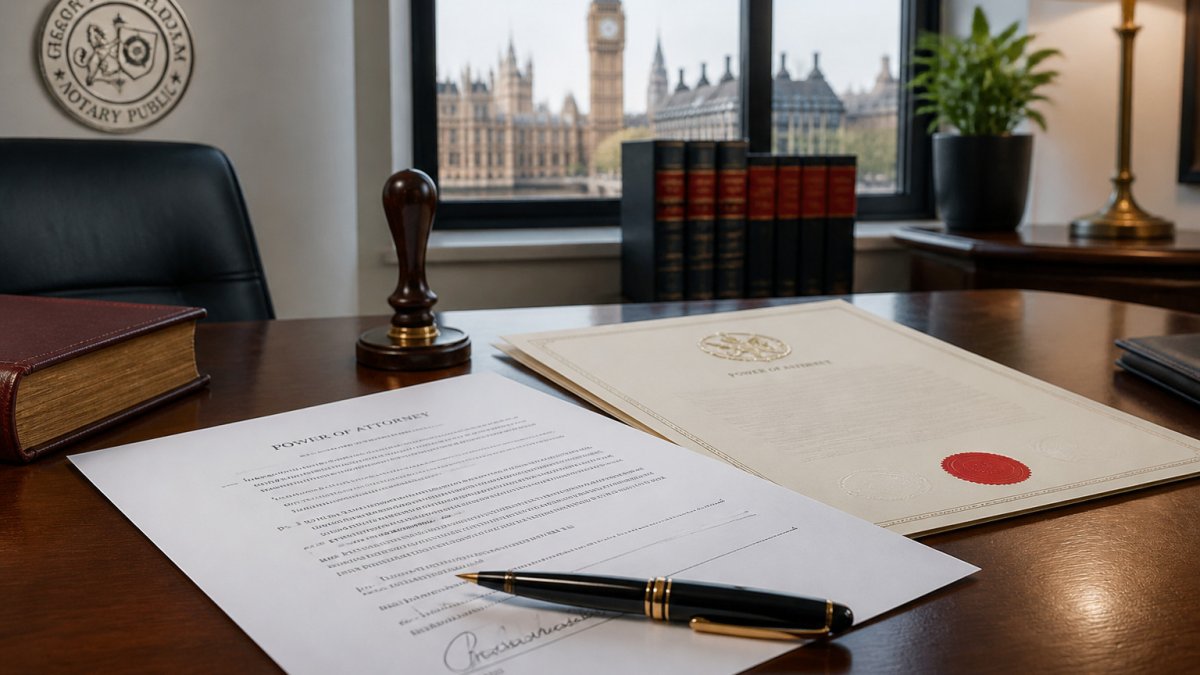
When you book, bring the Power of Attorney document, the signatory’s identification and a clear list of the institutions the document will be presented to. Our corporate and private notarial services cover documents authenticated for use in any country. Ask those institutions what certification they expect, because requirements differ.
Legalising Documents for Use Abroad: Apostille and Beyond
Once a UK document has been notarised, many countries require further authentication before they will accept it. You can arrange this through our apostille and legalisation service. The route depends on whether the destination is a party to the Hague Apostille Convention. Our apostille and legalisation process explained walks through each stage in detail.
Apostille for Hague Convention countries
For countries that are party to the Convention, an apostille certificate is usually sufficient. Check the relevant UK authority’s current published process, turnaround and fees before you plan, as these can change.
Legalisation for countries outside the Convention
For countries outside the Hague Convention, an apostille is not enough. The document may need further legalisation through the appropriate UK office and then the embassy or consulate of the destination country. Some destinations also require translation after legalisation, and a few require the translation itself to be certified or notarised. The sequence matters: presenting a document before the correct authentication is complete is a common reason for rejection.
The document-preparation workflow
A practical order of steps, which you should confirm with the receiving institution before you begin, is:
- Confirm requirements in writing with the overseas bank, court, land registry or agency, ask specifically whether it needs notarisation, an apostille, embassy legalisation, a certified translation, or a certified copy.
- Check the document is in order, including that the attorney’s authority covers the act in question and all local and English law formalities are complied with.
- Arrange certified copies if the institution will not accept the original. A notary can certify copies, but confirm whether the recipient wants the apostille on the original or on a certified copy.
- Notarise where required, with the signatory present and identification available.
- Obtain the apostille or legalisation in the correct order, FCDO first, then embassy or consulate where applicable.
- Commission a certified translation if the destination requires one, and check whether the translator must be approved or sworn in that country.
- Allow for processing time at each stage, including postal delays, and keep copies of everything you send.
Translation and certified copies
Translation requirements are set by the receiving authority, not by the UK. Some accept a translation by any competent translator; others require a certified or sworn translation, and a few require the translation to be legalised as well.
Watch out: the order of notarisation, apostille, embassy legalisation and translation is not interchangeable. A document legalised in the wrong sequence, or translated before the apostille is issued, is frequently rejected and has to be redone.
The route a document takes depends on whether the destination is a party to the Hague Apostille Convention, as summarised below.
|
Destination |
Route |
Key difference |
|---|---|---|
|
Hague Convention country |
FCDO Apostille certificate |
Usually sufficient on its own |
|
Country outside the Convention |
FCDO Apostille, then embassy or consulate |
An apostille alone is not enough |
|
Destination requiring translation |
Certified or sworn translation |
Requirements set by the receiving authority |
|
Any destination |
Notarisation first |
Does not by itself make a document valid abroad |
Checklist for Destination Countries and Overseas Banks
Use this checklist before you rely on a UK LPA abroad:
- Confirm the destination country’s rules on recognising foreign powers of attorney
- Ask the overseas bank or institution what documents, certification and translations it requires
- Check whether a local power of attorney is expected instead
- Confirm whether notarisation, an apostille or wider legalisation is needed
- Ask whether a certified translation must be provided
- Get written confirmation of acceptance where possible
- If refused, request the reason in writing and consult local legal counsel
Preparing Your LPA for Use Abroad and Next Steps
Start by identifying the country, the institution and the exact purpose, whether that is banking, property or a personal matter. Then gather the original LPA, confirm which type it is (property and financial affairs, or health and welfare), and work through the checklist above.
For help with notarising documents and preparing them for international use, contact Gregory Mappledoram, Notary Public. You can reach the office directly to arrange a same-day appointment in Canary Wharf or the City of London. Contact Gregory to book an appointment or ask a question about your document.
Frequently Asked Questions
Is a UK Lasting Power of Attorney valid in other countries?
A UK Lasting Power of Attorney is legally binding in England and Wales, but it does not grant authority automatically in other countries. Whether a foreign bank, court or authority accepts it depends on that country’s own law and practice. Recognition is not automatic, so the practical step is to ask the institution in advance what it requires. Many authorities will want the document notarised, legalised and translated, and some will ask for a local document instead.
Do I need an apostille for my Power of Attorney?
An apostille is often required when a UK document is presented in a country that is party to the Hague Apostille Convention, but not every destination requires one. An apostille confirms the authenticity of the signature and the authority of the signing official, and it is usually issued after the document has been notarised. Check with the receiving authority before you start, because asking for the wrong certificate causes delay and extra cost. Gregory can advise on the sequence for your destination.
Will foreign banks accept a UK Power of Attorney?
Foreign banks set their own acceptance criteria, and many will review a UK power of attorney carefully before acting on it. Expect requests for a certified copy, proof that the document is in force, notarisation or legalisation, and a certified translation if it is not in the local language. Some banks prefer their own form. Contact the institution early, confirm its requirements in writing, and allow time for the paperwork.
What is a notarised Power of Attorney?
A notarised power of attorney is a document whose signature has been witnessed and verified by a notary public, who confirms the identity of the signatory and that the signing took place as recorded. Notarisation does not decide whether the document is valid for a particular purpose, but it gives foreign authorities a reliable record to check. Notarisation is often the first step before legalisation or an apostille is added.
