
Table of Contents
- Step 1: Confirm Which Documents You Need to Legalise for Dubai
- Step 2: Have Documents Notarised by a UK Notary Public
- Step 3: Obtain a Foreign, Commonwealth and Development Office Apostille
- Step 4: Complete UAE Document Attestation UK Requirements
- Step 5: Prepare a Notarised Power of Attorney for Property in Dubai
- Common Mistakes When You Legalise Documents for Dubai
- Frequently Asked Questions
Last Updated: October 7, 2026
Step 1: Confirm Which Documents You Need to Legalise for Dubai
Before you spend a penny on notarisation or courier fees, work out exactly which papers the receiving authority in Dubai expects. The list depends entirely on what you are doing: taking a job, filing a court claim, registering a company, or selling property. (Source: FCDO guidance on legalisation and apostilles)
To legalise documents for Dubai from the UK, you are preparing them for a jurisdiction that requires a clear chain of authentication. That chain almost always runs: notary, then the Foreign, Commonwealth and Development Office, then the UAE embassy or consulate.
The most common documents we see at London Notary Services fall into four groups:
- Personal status papers: birth, marriage and death certificates, plus single-status declarations
- Academic records: degree certificates, transcripts and professional qualifications
- Corporate documents: board resolutions, certificates of incorporation, registers of directors
- Legal instruments: powers of attorney, affidavits, statutory declarations and contracts
Two rules save a lot of wasted effort and unnecessary additional expense. First, ask the end user, not a friend or a forum, what they need. Second, confirm whether the document must be an original or a certified copy. A rejected submission usually means starting the whole chain again.
Step 2: Have Documents Notarised by a UK Notary Public
A notary public is a legal officer, appointed by the Court of Faculties, who verifies signatures, identity and the authenticity of documents for use abroad. For Dubai, this notarial step is the foundation the rest of the chain sits on.
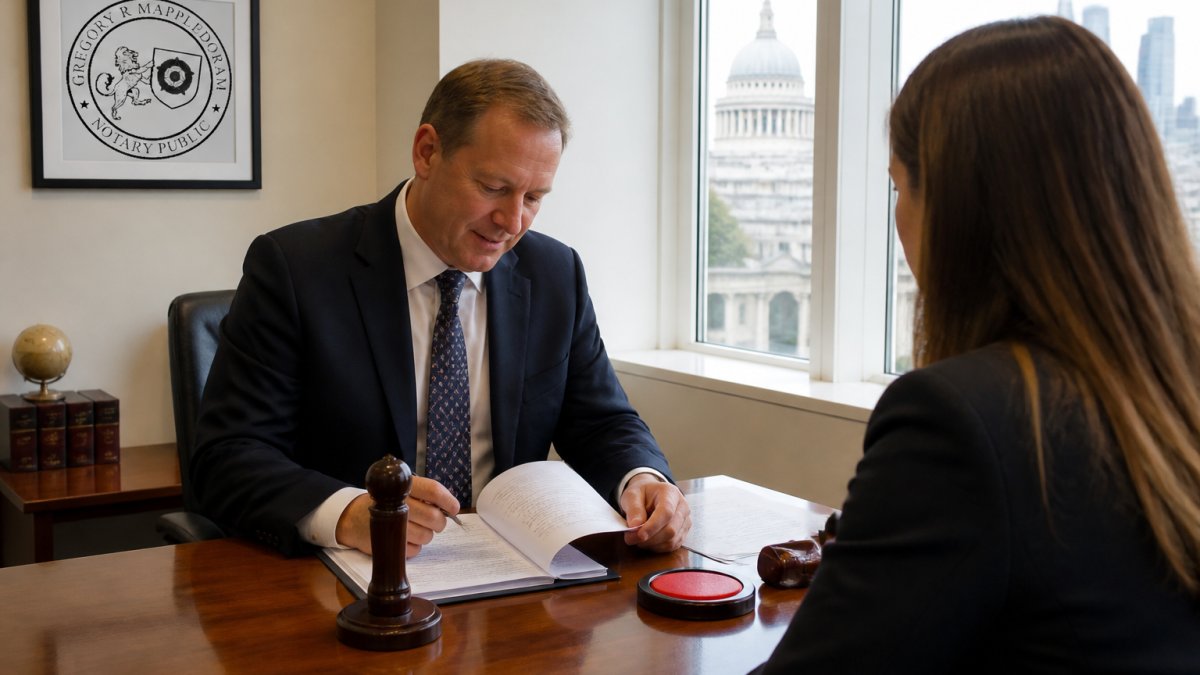
Bring the following to your appointment:
- The original document, unsigned
- Photo identification, such as a passport or driving licence
- Proof of address dated within the last three months
- Any supporting evidence the document refers to
Sign nothing in advance. The notary must witness the signature in person. For corporate documents, the signatory also needs authority to bind the company, so bring evidence of that authority.
Most routine notarisations are straightforward. Complex corporate bundles, or documents in a language the notary cannot read, take longer and may need a certified translation first. If you are facing a deadline, tell the notary at the point of booking, because same-day appointments are often possible when the paperwork is ready.
Step 3: Obtain a Foreign, Commonwealth and Development Office Apostille
An apostille is a certificate that confirms the signature and seal of a UK public official, such as a notary, are genuine. For Dubai, a notarised document is not finished until it carries one.
The FCDO guidance on legalisation and apostilles confirms that the Legalisation Office is the only UK body that can issue an apostille. You post or courier the notarised document to the Legalisation Office, or use a service that handles the submission for you.
A few practical points:
- Apostilles attach to the notary’s signature, so the order matters
- Standard turnaround is usually 2-3 working days, with a faster service available
- Check the document is signed and sealed correctly before posting if you are getting the apostille yourself. Gregory can obtain the apostille for you as part of his service.
If the apostille is placed on the wrong page, or the notary’s details do not match, the document comes back rejected. That is a delay nobody with a closing date can afford.
Step 4: Complete UAE Document Attestation UK Requirements
UAE document attestation UK requirements mean the document must be stamped by the UAE embassy or consulate in London after the apostille. This is the step that makes the paper acceptable to UAE authorities on arrival.
You submit the apostilled document to the UAE consular section, which legalises the FCDO’s stamp. Some documents also need a final attestation through the UAE Ministry of Foreign Affairs once they are in Dubai. The UAE Ministry of Foreign Affairs attestation portal lets the receiving party verify a document digitally.
Each document must be notarised separately in order to be accepted in the UAE, you cannot bundle documents together.
|
Step |
Who does it |
Typical order |
|---|---|---|
|
Notarisation |
UK notary public |
1 |
|
Apostille |
FCDO Legalisation Office |
2 |
|
Consular legalisation |
UAE embassy or consulate |
3 |
|
MOFA attestation |
UAE Ministry of Foreign Affairs |
4 |
Get the order wrong and the chain breaks. Each stamp validates the one before it, so there is no shortcut.
Step 5: Prepare a Notarised Power of Attorney for Property in Dubai
A notarised power of attorney for property lets someone act on your behalf in Dubai when you cannot be there in person. It is one of the most common documents we prepare for clients with overseas property interests.
The document must be drafted carefully. It needs to name the attorney, set out the exact powers granted, and state any limits. Vague wording is a common reason UAE authorities query a power of attorney.
For a Dubai property transaction, the power of attorney usually needs:
- The full names and details of both parties
- A precise description of the property or the transaction
- The specific powers, such as signing contracts or completing a transfer
- A validity period, if the arrangement is time-limited
Remember that the Power of Attorney must also comply with the formalities of a Power of Attorney under the Powers of Attorney Act, 1971. Once signed and witnessed by the notary, the document follows the same chain: apostille, then UAE consular legalisation. Because the stakes are high, we recommend drafting it with legal advice for the destination jurisdiction, not just the UK.
Common Mistakes When You Legalise Documents for Dubai
The same avoidable errors come up again and again. Fixing them before you start saves days.
- Apostille before notarisation. The FCDO must authenticate the notary’s signature, so the notary goes first.
- Wrong document version. Some authorities want originals, others accept certified copies. Confirm before you order anything.
- Missing translation. Documents not in Arabic may need a certified translation.
- Signing too early. A document signed before the notary appointment cannot be properly witnessed.
- Assuming one size fits all. Requirements differ by authority and by document type.
If you are unsure at any point, ask the receiving authority directly. A five-minute email now beats a rejected bundle later.
Legalising documents for Dubai is unforgiving about order and detail, and a single wrong step can send you back to the start and be an expensive mistake. Gregory Mappledoram, Notary Public, brings over 18 years of notarial experience and 25 years as a General Counsel, so your documents are prepared to work in the destination jurisdiction. We offer same-day service for time-pressured transactions, and practical support for in-house legal teams and referring solicitors. Contact Gregory to get your documents legalised correctly the first time.
Frequently Asked Questions
What is the process for document attestation for Dubai?
The process involves three main stages: notarisation by an English notary public, certification by the Foreign, Commonwealth and Development Office (FCDO) with an apostille, and finally attestation by the UAE Embassy in London. Some documents may also require translation into Arabic before the final step. Each stage must be completed in order, and the document must bear the correct stamps and signatures from the previous stage before progressing to the next.
Do I need a notary public to legalise documents for the UAE?
Yes, in most cases. For documents issued in the UK that will be used in Dubai, a notary public must first verify the document’s authenticity and witness any required signatures. This notarised document then goes to the FCDO for an apostille. Without the initial notarisation, the FCDO and UAE Embassy will not process the document. Corporate documents such as board resolutions, powers of attorney, and certified copies of company registers all require notarial certification.
How long does the document legalisation process take?
Timelines vary depending on the type of document and the current processing times at the FCDO and UAE Embassy. Notarisation can often be arranged same-day or within 24 hours. FCDO apostille processing typically takes 2-3 working days, and UAE Embassy attestation can add further time – currently 10-14 days as the UAE Embassy in London only accepts postal applications. For urgent cross-border transactions, it is advisable to instruct a notary who can advise on expedited options and manage the sequence efficiently.
Can I get my documents legalised for Dubai in the UK?
Yes. UK-issued documents can be fully legalised for use in Dubai without leaving the country. The process is handled through a UK notary public, the FCDO, and the UAE Embassy in London. Documents issued in other countries must generally be legalised in the country of issue first, then attested by the UAE Embassy covering that jurisdiction. For UK documents, the entire chain can be completed domestically.