Last Updated: 2 November 2026
Quick Summary
To legalise documents for Dubai, UK papers go through three stages in a fixed order: notarisation, then an FCDO apostille, then with UAE Embassy attestation in London and MOFA attestation in the UAE. Documents issued outside the UK must start the chain in their country of issue instead.
- Personal and commercial documents both need the full authentication chain before a UAE authority will accept them.
- A notary must witness a power of attorney signature in person, you cannot sign first and certify afterwards.
- Educational certificates may need verification by the awarding institution before notarisation, the most common cause of stalled files.
- Work backwards from your deadline and add a buffer for one rework cycle, as a single rejection resets that stage.
- Most rejections trace to a missing chain link, an uncertified translation or a name mismatch with the passport.
Table of Contents
- Which Documents Need Legalising for Dubai
- The Dubai Document Attestation Process, Step by Step
- How to Legalise a Birth Certificate for Dubai
- How to Legalise a Power of Attorney for Dubai
- How Long Does UAE Document Legalisation Take?
- Avoiding Rejections and Delays
- Contact Gregory to Start Your Legalisation
- Frequently Asked Questions
Which Documents Need Legalising for Dubai
Documents bound for the UAE fall into two groups: personal papers and commercial papers. Personal documents include birth certificates, marriage certificates, decrees absolute and degree certificates. If you are unsure how to legalise documents for Dubai, start by identifying your document type, because the route differs at the first stage. (Source: legalisation services)
The UAE generally requires public documents to go through a chain of authentication before a UAE authority will rely on them. For UK documents, that chain typically involves a notary, the Foreign, Commonwealth & Development Office (FCDO) and the UAE Embassy in London.
Original documents are preferred. Some UAE bodies accept a certified copy, but you should confirm the requirement with the receiving authority before you spend money on certification.
The Dubai Document Attestation Process, Step by Step
The Dubai document attestation process has three stages, and they run in a fixed order. Skip one and the next will fail. Before you pay anyone, use the decision tree below to confirm which route your document needs, because the first stage, and sometimes the whole chain, changes depending on where the document was issued and what type it is.
Decision tree: which route does your document need?
Work through these questions in order. The first “yes” determines your route.
- Was the document issued outside the UK? If yes, the chain starts in the country of issue, not in London. You will usually need authentication by that country’s competent authority, then attestation by the UAE Embassy accredited to that country, then MOFA in the UAE. An FCDO apostille is not the starting point for a foreign-issued document, and in many cases an apostille alone will be rejected. Confirm the correct embassy (the UAE has embassies in most capitals but not all) before posting anything.
- Is it a public document issued by a UK registrar or court (birth, marriage, decree absolute, probate)? If yes, you normally start with a certified copy or an official extract, then notarisation certification, then FCDO apostille, then UAE Embassy attestation, then MOFA. Some registrars issue a certified copy that don’t need any notarial intervention e.g. a birth certificate; others require the notary to see the original first. Where a document issued by the UK Government (other than a birth, marriage or death certificate) that does not have a wet ink signature, will need to be notarised first.
- Is it a private document you or your company will sign (power of attorney, board resolution, company register, commercial invoice)? If yes, the notary must witness the signature in person, you cannot sign first and have it certified afterwards. Then FCDO apostille, UAE Embassy attestation, MOFA.
- Is it an educational certificate (degree, transcript, professional award)? If yes, the awarding institution may need to confirm the award before notarisation. Some UAE authorities also require the certificate to be verified by the awarding body or a recognised verification service before the embassy will attest it. Build this step into your plan, it is the most common cause of a stalled educational file. Gregory Mappledoram Notary Public will verify the award with the issuing academic institution as part of the notarisation process.
- Is it a digital or e-signed document? If yes, check with the receiving UAE authority before you start. Many UAE bodies still require a wet-ink original or a certified paper copy, and an electronically issued record may need to be printed and certified by the issuing body first. Do not assume an e-signature will be accepted at the embassy stage.
If more than one route applies, for example a UK-issued degree being used by a company, follow the strictest route, which is usually the one requiring institutional verification plus the full chain.
Step 1: Notarisation Certification
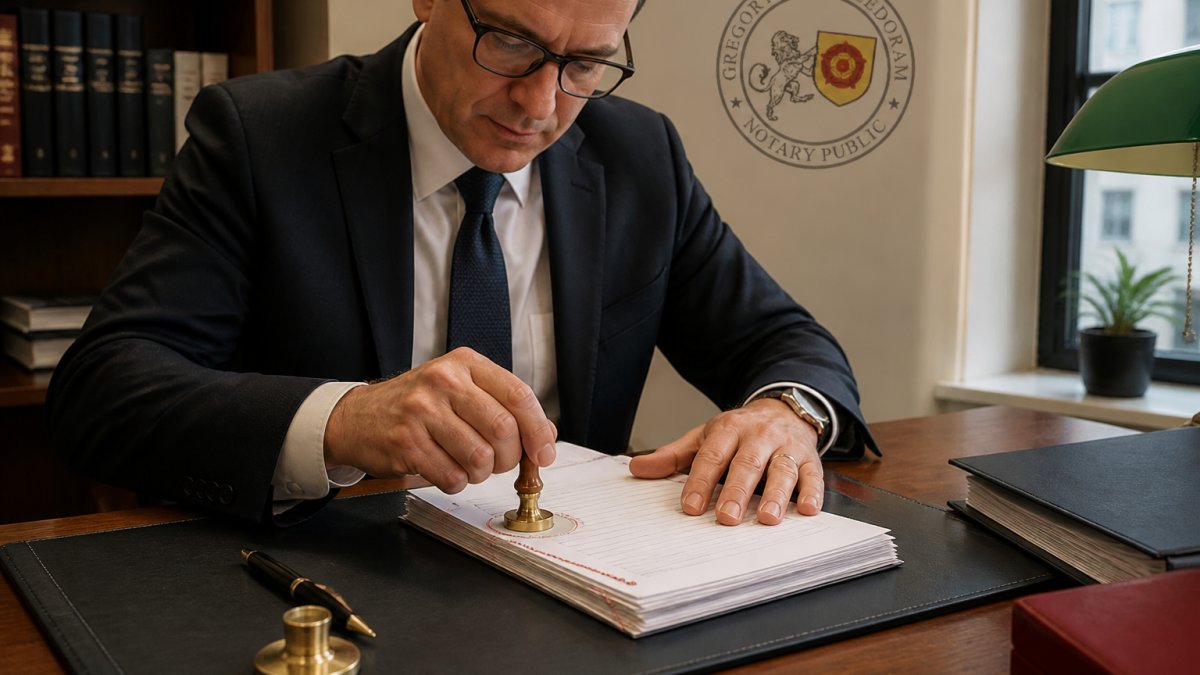
A notary public certifies that the document is genuine and that the signature is genuine.
Bring photo ID and the original document. A notary cannot act on a photocopy alone.
Step 2: FCDO Apostille and UAE Embassy Attestation
The FCDO checks the notary’s signature and adds an apostille certificate. The document then goes to the UAE Embassy in London for consular attestation. The UAE Embassy has moved towards an electronically issued legalisation page, according to Rouse’s 2026 report on the new consulate legalisation format, so confirm the current format when you submit. Our apostille and legalisation service explains the options if you would rather have this handled for you.
Two mechanics matter here. First, the FCDO apostille is a check of the notary’s signature, not of the document’s contents, if the underlying document is defective, the apostille will still be issued and the rejection will happen later, at the embassy or in the UAE. Second, the embassy stage is where document type matters most: commercial documents, powers of attorney and educational certificates are often reviewed more closely than birth or marriage certificates, and the embassy may query wording, seals or translations.
Step 3: MOFA Attestation in the UAE
The UAE Ministry of Foreign Affairs (MOFA) applies the final attestation once the document arrives in the country. The MOFA attestation service page sets out the online route: the applicant selects the destination country, uploads the original digital document issued by the competent authority and confirms a declaration.
MOFA is also where the receiving authority’s own requirements surface. A free-zone authority, a court, a land department and a bank may each ask for a different combination of attestations, translations and copies.
What the full chain costs, stage by stage
Costs vary by document, provider and speed. Typical cost components include the following:
- Notarisation or solicitor certification: a fee set by the notary and depends on the type of document.
- FCDO apostille: a government fee, plus postage or courier costs.
- UAE Embassy attestation: a consular fee that differs by document type, plus any agent handling fee. The UAE legalisation is one of the more expensive legalisation processes so getting the document right first time saves wasted costs.
Ask any provider for a written, itemised quote that separates government fees from service fees.
Documents issued outside the UK
If your document was issued in another country, the UK chain is the wrong chain. The document normally needs authentication in its country of issue, then attestation by the UAE Embassy covering that country, then MOFA. The FCDO apostille applies to UK public documents, and a foreign document may still need embassy legalisation before MOFA will accept it. Check the UAE Embassy’s published requirements for the issuing country before posting anything, and allow extra time for international courier legs in both directions.
How to Legalise a Birth Certificate for Dubai
A birth certificate follows the same three-stage chain, but the starting point is different. A UK issued birth certificate does not need notarisation and can be submitted for an apostille directly. If it is a foreign birth certificate, check it can be processed in the UK (if not the process starts in the country it was issued in) and if so a certified copy of the certificate is notarised first, then apostilled by the FCDO, attested by the UAE Embassy and finally stamped by MOFA.
Two practical points catch people out:
- Some UAE authorities ask for an Arabic translation of the certificate. Use a certified translator and confirm whether the translation itself needs attestation.
- If the certificate was issued outside the UK, the chain starts in the country of origin, not in London.
How to Legalise a Power of Attorney for Dubai
A power of attorney for Dubai must be signed in front of a notary, not certified afterwards. The notary verifies your identity, witnesses your signature and confirms you understand the document.
Then follow the same route: FCDO apostille, UAE Embassy attestation, MOFA. Build in extra time for the UAE side to review the wording. A poorly drafted power of attorney is one of the most common reasons a property or court matter stalls.
How Long Does UAE Document Legalisation Take?
Timelines vary by route, and no honest provider will promise a fixed number of days for the whole chain. What you can do is plan stage by stage, because each stage has its own queue, its own dispatch time and its own failure mode. The table below sets out a realistic planning pattern rather than a guarantee.
|
Stage |
Who handles it |
Typical waiting pattern |
What can add time |
|---|---|---|---|
|
Document preparation |
You or the issuing body |
Same day to several days |
Reordering a certified copy, institutional verification of a degree, certified translation |
|
Notarisation |
Notary public |
Often same day by appointment |
Signing must be witnessed in person; company documents need director ID and authority checks |
|
FCDO apostille |
FCDO |
Several working days |
FCDO Processing times |
|
UAE Embassy attestation |
Embassy in London |
Varies by document type but typically 2-3 weeks |
Queries on wording, seals or translations; commercial and POA files reviewed more closely. There is no in-person application for legalisation so postage and processing result in delays. |
|
International dispatch |
Courier |
A few working days each way |
Customs, missing paperwork, weekend cut-offs |
|
MOFA attestation |
UAE Ministry of Foreign Affairs |
Depends on the UAE contact |
Receiving authority queries; rework if the end user wants a different combination |
Standard route versus agent-assisted route
On the standard route you post the document to the FCDO, wait, post it to the embassy, wait, then arrange international dispatch to a UAE contact who completes MOFA. Each postal leg adds transit time and each handover adds a day or two of admin. An agent-assisted route can sometimes shorten the UK stages, depending on the provider. It does not remove the embassy’s review time or MOFA’s queue, so treat any promise of a fixed end-to-end number of days with caution. Gregory always uses the services of a legalisation agent to obtain the apostille and legalisation at the UAE embassy.
Planning around a deadline
Work backwards from the date the UAE authority needs the document, not forwards from today. Add a buffer for one rework cycle, because a single rejection at the embassy or MOFA resets that stage and may require a fresh notarisation. If a deadline is tight, start the notarisation immediately, everything downstream depends on it, and ask the receiving authority in writing which attestations and translations it will accept, so the file is built once. For current pricing and a quote, see the notary fees page.
What makes a file slower than expected
The most common causes of delay are not government queues. They are a name mismatch between the document and the passport, a certified copy where the authority wanted the original, a translation that was not certified, and a power of attorney whose wording the UAE side asks to be redrafted. Each of these is preventable.
Avoiding Rejections and Delays
Most rejections trace back to one of four causes:
- A missing link in the chain, such as an apostille with no embassy attestation.
- A certified copy where the authority wanted the original.
- A translation that was not certified.
Check the spelling of every name before you submit. A middle name missing from a birth certificate will stop a UAE application. Our guide on how to avoid document rejection abroad covers the checks in more detail.
Contact Gregory to Start Your Legalisation
The challenge is not knowing the steps. It is getting every link in the chain right the first time, especially when a transaction cannot slip.
Gregory Mappledoram has over 18 years of notarial experience and 25 years as a General Counsel. For the full companion guide, read how to legalise documents for Dubai.
Get started with Gregory and move your Dubai documents through the chain without a rejected application. Contact Gregory to arrange your appointment.
Frequently Asked Questions
What is the difference between an apostille and document attestation for Dubai?
An apostille is a single certificate issued under the Hague Apostille Convention that confirms the authenticity of a UK public official’s signature, seal or stamp. Attestation for Dubai is a longer chain: notarisation certification, then the FCDO apostille, then UAE Embassy attestation, and finally MOFA attestation in the UAE. The apostille is one link in that chain, not the whole process. Documents bound for Dubai normally need the full sequence because the UAE requires consular and MOFA legalisation on top of the FCDO check.
Do UK documents need to be notarised before legalisation for Dubai?
In most cases, yes. The FCDO will only apostille a document that has first been signed or certified by a recognised UK public official, and for private documents such as powers of attorney, company resolutions or certified copies, that means a notary public. The notary verifies identity, witnesses the signature and applies an official seal. Skipping this stage is one of the most common reasons applications are rejected further down the chain, so confirm the requirement with your notary before submitting anything.
Can I legalise a document for Dubai online?
Part of the route can start online. The UAE Ministry of Foreign Affairs handles the UAE stage of attestation. Check its official website for current application options. However, the UK-side stages, including notarisation and the FCDO apostille, still require the physical or properly certified document. Treat online tools as a way to begin or track the process, not a replacement for the full chain of authentication.
Do documents for Dubai need to be translated?
Arabic translation is often required, particularly for personal documents such as birth and marriage certificates and for powers of attorney. The translation normally needs to be certified and may itself need legalising, so build it into your timeline rather than treating it as an afterthought. Requirements vary by the receiving authority in Dubai, so confirm the exact translation and certification standard with them before you commission anything.