Last Updated: 30 October 2026
Quick Summary
To legalise documents for Singapore, first have private documents notarised by a notary public, then send the original to the FCDO for an apostille under the Hague Apostille Convention. Public documents often need only the apostille, so confirm the exact requirement with the receiving body in Singapore first.
- Confirm with the receiving body in Singapore whether an apostille or only a notarial certificate is needed.
- Notarise first, then legalise: an unnotarised private document cannot be apostilled.
- The FCDO issues apostilles for UK documents; send the original, not a photocopy.
- Foreign-issued documents are legalised in the country of issue, not by the FCDO.
- Common rejections include signing before the appointment and incomplete documents.
Table of Contents
- Step 1: Confirm Singapore Actually Needs a Legalised Document
- Step 2: Understand Notarisation and Legalisation of Documents for Singapore
- Step 3: Get the Document Notarised by a Notary Public
- Step 4: Check the Singapore Apostille Requirements
- Step 5: Arrange the Apostille for Documents Going to Singapore
- Step 6: Match Each Document Type to Its Legalisation Route
- Step 7: Fix Rejected Applications Before You Resubmit
- Book a Notary for Your Singapore Document Set
- Frequently Asked Questions
Step 1: Confirm Singapore Actually Needs a Legalised Document
Before you spend time and money to legalise documents for Singapore, check that it actually requires it. Many documents travel to Singapore without any formal legalisation, so confirming the requirement first saves you a wasted appointment.
Singapore is a party to the Hague Apostille Convention (HCCH | #12). Confirm with the receiving body whether an apostille satisfies its requirements.
But not every document needs one. Ask the receiving body in Singapore, whether that is a government agency, court, bank or company, what it will accept. Get the answer in writing if you can.
A quick checklist:
- Confirm the exact document the recipient wants
- Ask whether they need an apostille or only a notarial certificate
- Check whether they accept a certified copy or insist on the original
- Note any deadline so you can plan the appointment
If you have quick questions about notarisation and legalisation before committing, our frequently asked questions cover the basics.
Step 2: Understand Notarisation and Legalisation of Documents for Singapore
When you legalise documents for Singapore, notarisation and legalisation are two different steps, and mixing them up is the most common reason documents get held up. Notarisation is the act of a notary public verifying your identity, witnessing your signature and certifying the document. Legalisation is the separate process that makes a UK document acceptable to authorities in another country.
For Singapore, legalisation usually means an apostille issued under the Hague Apostille Convention. The Foreign, Commonwealth & Development Office (FCDO) issues apostilles for UK documents.
So the order matters: notarise first, then legalise. A document that has not been properly notarised cannot be apostilled.
If you want the difference explained in more detail, read our guide to the apostille and legalisation process before you book anything.
Watch out: sending a document straight to the FCDO without the required notarial certificate is a common mistake, and it comes back rejected.
Step 3: Get the Document Notarised by a Notary Public
A notary public is a public officer and legal professional authorised to verify signatures, administer oaths and certify documents for use abroad. Notaries in England and Wales are appointed through the Faculty Office of the Archbishop of Canterbury.
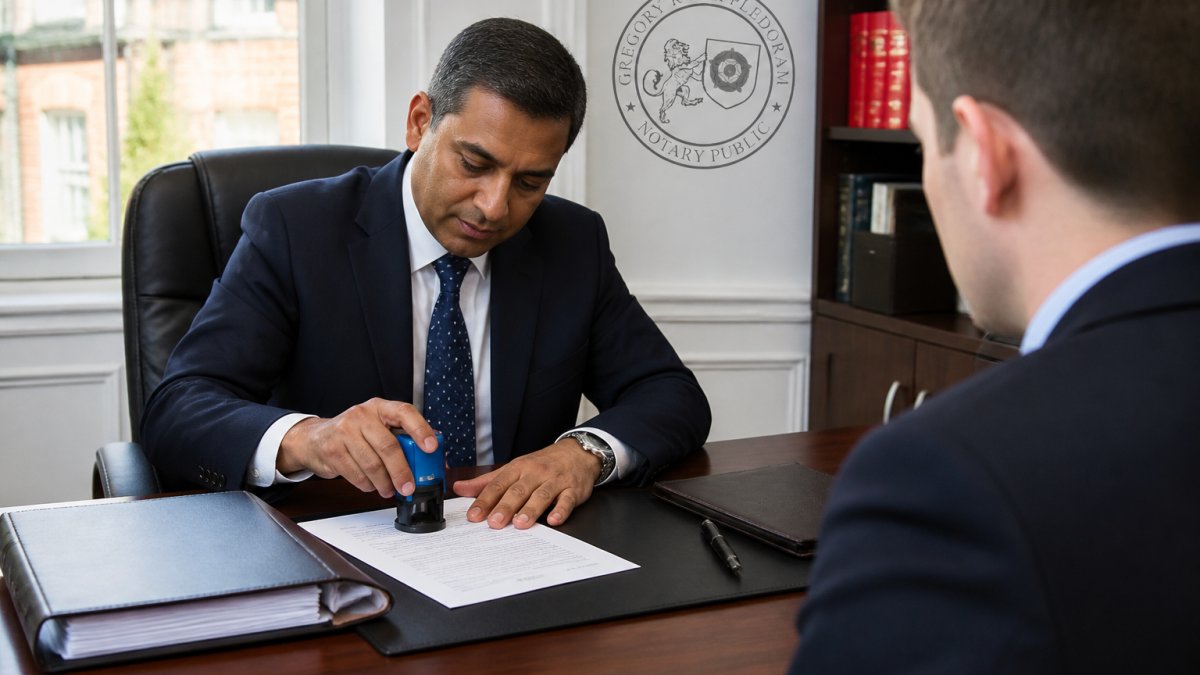
Book an appointment and bring:
- The original document, unsigned
- Valid photo ID, such as a passport or driving licence
- Proof of address
- Any instructions from the receiving body in Singapore
The notary will check your identity, watch you sign, and attach a notarial certificate with a signature and official seal.
Gregory Mappledoram, Notary Public, has over 18 years of notarial experience and can handle time-pressured matters, including same-day service.
Step 4: Check the Singapore Apostille Requirements
The key requirement is straightforward: the document must be a UK public document, or a private document that has been properly notarised, before the FCDO will apostille it. An apostille is a certificate fixed to the document confirming the authenticity of the signature, seal or stamp on it.
What the FCDO checks before issuing an apostille:
- The notarial certificate is complete and correctly signed
- Names and dates match
- The signature or seal on the document is one the FCDO recognises
The two directions, do not blur them:
Search results often mix two distinct processes. Keep them separate:
- UK-issued documents going to Singapore. The route is notarisation (where required) followed by an FCDO apostille. This is the process described in this article.
- Foreign-issued documents being used in Singapore. These do not go to the FCDO. Instead, the document is legalised in the country of issue and then it can be used in Singapore.
If your document was issued outside the UK and is destined for use in Singapore, confirm the inbound route with the receiving body before you start. Do not assume the UK apostille process applies.
Electronic apostilles and verification:
Some documents can be legalised electronically where the issuing body supports it. Some apostilles can be issued electronically, so check with the FCDO and the recipient which format applies.
For current processing times and submission methods, check the FCDO guidance on getting documents legalised directly, as these change.
Step 5: Arrange the Apostille for Documents Going to Singapore
Once notarised, the document goes to the FCDO for the apostille. Gregory provides a holistic services where he can assist you in obtaining the apostille from the FCDO as part of the overall service.
Practical points that catch people out:
- Send the original, not a photocopy
- Keep copies of everything before posting
- Use tracked delivery both ways
- Check whether the Singapore recipient wants a physical apostille or accepts a digital one
Confirm with the recipient in Singapore whether an electronic apostille is acceptable for your matter.
If you would rather have the notarisation and apostille handled together, you can arrange apostille and legalisation through our service rather than chasing each stage yourself.
Step 6: Match Each Document Type to Its Legalisation Route
Different documents take different routes, and getting this wrong wastes a trip. The table below is a working guide, but the decisive question is not the document type alone, it is what the receiving body in Singapore will accept. Use the decision sequence first, then the matrix.
Decision sequence before you book anything:
- Confirm the receiving body accepts an apostille. Singapore is a party to the Hague Apostille Convention, so a UK apostille is normally sufficient for UK-issued documents. Ask the specific agency, court, bank or company to confirm in writing.
- Confirm whether the recipient wants the original, a certified copy, or a notarised copy. Some Singapore bodies insist on sight of the original; others accept a certified copy apostilled in place of the original.
- Confirm whether the document is public or private in UK terms. Public documents (for example, certificates issued by a UK registrar or a court) can often go straight to the FCDO for an apostille. Private documents (powers of attorney, contracts, company resolutions) generally need notarisation first.
- Confirm whether the Singapore recipient needs anything beyond the apostille. A minority of matters still require consular legalisation or a specific certification chain so check before you post.
Document-by-document matrix:
|
Document type |
Typical route |
What to watch |
|---|---|---|
|
Birth, marriage, death certificates (UK-issued) |
Apostille only |
Public documents; confirm whether the recipient accepts a certified copy rather than the original |
|
Company documents, board resolutions, certificates of incorporation |
Notarise, then apostille |
Common for corporate and banking matters; confirm whether the recipient wants the full set or extracts |
|
Powers of attorney |
Notarise, then apostille |
Signature must be witnessed by the notary; check whether the Singapore recipient requires a specific form of words |
|
Educational certificates and transcripts |
Notarise, then apostille |
Confirm whether the awarding body must certify first; some institutions issue their own certified copies |
|
Commercial contracts |
Notarise, then apostille |
Check whether the recipient wants the full contract or extracts; page numbering matters |
|
Identity documents (passport, driving licence) |
Certified copy, then apostille |
Originals are rarely sent abroad; confirm the copy is certified in the form the recipient expects |
|
Court documents (UK-issued) |
Apostille only, or notarise then apostille |
Depends on whether the court issues a certified copy; confirm with the issuing court |
|
Statutory declarations and affidavits |
Notarise, then apostille |
The notary administers the oath or affirmation; check the recipient’s format requirements |
Public versus private, the practical distinction:
Public documents issued by UK authorities often need only the apostille. Private documents, such as powers of attorney or contracts, almost always need notarisation first. If you are unsure which category your document falls into, ask before you book. A short written confirmation from the receiving body in Singapore is worth more than any general guidance, because requirements vary by agency and by matter.
If you are unsure which category your document falls into, ask before you book.
Step 7: Fix Rejected Applications Before You Resubmit
Rejection is usually fixable, and it is rarely about the substance of the document. The common causes are procedural.
The usual culprits:
- The document was signed before the notary appointment
- Pages were missing or out of order
- The apostille was requested on an unnotarised private document
- The Singapore recipient wanted a different document version
When a document comes back, read the rejection notice carefully and note exactly what was flagged. Then correct that specific point rather than resubmitting the same paperwork.
Our article on why international legal documents get rejected explains the recurring causes and how to fix them before you resubmit.
Book a Notary for Your Singapore Document Set
Getting a document ready for Singapore is a sequence, not a single step. Confirm the requirement, notarise correctly, then arrange the apostille, and most problems disappear before they start.
If you are working to a deadline, whether a cross-border transaction, a property matter or a corporate filing, Gregory can help you. Gregory brings over 18 years of notarial practice and 25 years as a General Counsel, with same-day appointments available and documents prepared for the destination jurisdiction.
Get in touch to contact Gregory and confirm what your Singapore document set needs.
Frequently Asked Questions
Can I legalise a document issued in the UK for use in Singapore?
Yes. A UK-issued document intended for Singapore normally needs notarisation by a UK notary public, followed by an apostille from the Foreign, Commonwealth and Development Office. The order matters: the apostille confirms the notary’s signature and seal, so it must come after notarisation, not before. Check with the Singaporean receiving body first, because some public authorities and private organisations ask for additional steps or a certified translation.
Do documents need an apostille for use in Singapore?
Singapore is a party to the Hague Apostille Convention, so an apostille is normally the accepted form of authentication for foreign public documents. In practice this means a UK document legalised with an apostille should be accepted without consular legalisation. Confirm with the specific Singaporean authority or counterparty, since acceptance requirements can vary between government bodies and private institutions.
How long does it take to legalise documents for Singapore?
Timing depends on three things: how quickly the notary can see you, the FCDO’s apostille turnaround, and any courier time to Singapore. The apostille stage is the variable one, and turnaround depends on the service chosen. Build in extra days if your document needs a certified translation or if the receiving body has its own review queue.
How do I get a document notarised before legalisation?
Book an appointment with a notary public and bring the original document, valid photo identification, and evidence of your authority to sign if you are acting for a company. The notary verifies your identity, witnesses the signature and applies a notarial certificate and seal. Tell the notary the document is destined for Singapore so the certificate is prepared in a form the receiving authority will accept. Never sign in advance.
The real risk with Singapore documents is not the notarisation itself, it is the sequence. One missed certificate or an unsigned original can send the whole set back. London Notary Services handles notarisation and can guide you through the apostille stage, with same-day appointments, documents prepared for the destination jurisdiction, and the backing of professional indemnity and fidelity cover. Get started with London Notary Services and send your documents to Singapore with confidence.

Leave a Reply